

Every host who has ever had a full recording calendar knows the feeling.
The episodes are scheduled. The guests are confirmed. The next 4 weeks of recordings are locked in and the only thing left to do is show up and have the conversations.
Most hosts also know what happens 2 weeks later.
The calendar clears faster than expected. The pipeline that looked full suddenly looks thin.
The search for guests starts again from scratch and the urgency of the empty slots produces the same rushed outreach that produced the inconsistent episodes the last time.
The pattern repeats because filling a calendar is treated as a periodic task rather than a continuous system.
A calendar that fills itself month after month isn’t the result of doing more outreach.
It’s the result of building a pipeline that has inbound flow, active outreach, and a follow-up structure all running simultaneously rather than sequentially.
Why a Pipeline Produces Different Results Than a Search
A search produces podcast guests for the slots that are empty right now.
A pipeline produces guests for the slots that will be empty in 4, 6, and 8 weeks, before those slots feel urgent.
The difference sounds like a timing preference. The actual difference is in the quality of the decisions made in each state.
A host searching for guests to fill empty slots this week is making decisions under urgency.
Urgency produces availability bias: the podcast guest who responds fastest gets the slot, regardless of whether they’re the best fit for the show’s audience right now.
The resulting episodes reflect the decision quality of urgency rather than the decision quality of selection.
A host managing a pipeline is making decisions from a position of advance inventory. Slots four weeks out can be filled with the guests who are the best fit rather than the guests who are the most available.
The resulting episodes reflect the decision quality of selection rather than urgency.
Building the pipeline is the work. Filling the calendar is the outcome.
4 Components of a Podcast Guest Pipeline That Compounds
A pipeline that keeps a recording calendar consistently full has 4 components running simultaneously. Each one feeds the next and all 4 together produce the continuous inflow that makes urgency-based booking unnecessary.
1. 🔍 A consistent matching and connection activity

The top of the pipeline is the rate at which new guest conversations are being started.
What consistent activity looks like: A set number of connection requests sent per week rather than a burst of outreach followed by weeks of inactivity. 30 Pro connections per month sent at a rate of 7 to 8 per week produces a steadier inflow of new conversations than thirty sent in the first three days of the month.
What inconsistent activity produces: A calendar that cycles between feast and famine. A burst of outreach produces a burst of recordings 4 to 6 weeks later, followed by a gap while the next burst of outreach catches up.
The rate worth targeting: Enough new connections per week to keep the active stage of your inbox populated with conversations that are progressing, without sending so many that the follow-up and scheduling work becomes unmanageable.
2. 📅 A scheduling buffer of 4 to 6 weeks
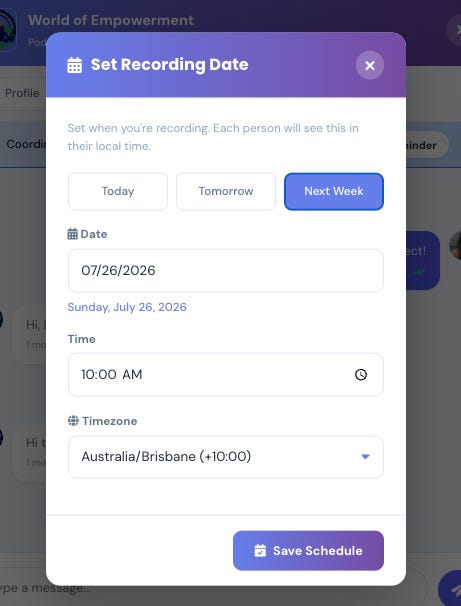
A pipeline that only books podcast guests for the next 2 weeks is a pipeline that always feels urgent.
What a 4 to 6 week scheduling buffer produces: Time to be selective. A podcast host booking guests 4 weeks out can choose the best-fit guest from multiple options rather than the first available guest from limited options.
What it produces for episode quality: Podcast guests who are confirmed further in advance have more time to prepare, are less likely to cancel, and arrive at the recording with more thought given to what they want to deliver to the show’s audience.
How to build the buffer from a standing start: For the first month send connections at a higher rate than your regular cadence and book all confirmed guests 4 to 6 weeks out rather than as soon as possible. The initial discomfort of a near-empty near-term calendar resolves itself within 30 days and the buffer becomes self-sustaining.
3. 🔄 A re-engagement system for warm connections
Not every connection that goes quiet is a dead conversation. Some are podcast guests who were interested at the time of connection and had their attention pulled elsewhere.
What a re-engagement system looks like: A structured process for periodically revisiting conversations that stalled before reaching the scheduled stage and sending a brief, pressure-free message that re-opens the possibility.
What re-engagement produces for pipeline consistency: A secondary inflow of guests who didn’t convert on the first pass but convert on the second. In a well-maintained pipeline re-engagement typically recovers 10-20% of stalled conversations into recorded episodes.
When re-engagement is worth attempting: For conversations that showed genuine interest before stalling, where the podcast guest’s profile is still a strong fit for the show’s current direction. Not for conversations that stalled because the fit was unclear or the guest was unresponsive from the start
4. ⭐ A referral mechanism that generates inbound guest applications

The most efficient source of quality guests for any show is the guests already recorded.
What asking for referrals produces: Warm introductions to guests who are pre-qualified by the fact that someone who knows your show vouched for them. A referred guest arrives with an implicit endorsement from the referring guest, which reduces the qualification work and increases the probability of a great episode.
When to ask: After the recording is complete and before the episode publishes. The host and guest have just had a great conversation and the referring guest is in the optimal emotional state to think of who else in their network would be a fit.
What to say: “I really enjoyed our conversation. If you know anyone in your network who would be a strong fit for the show I’d genuinely appreciate an introduction.” Specific, low-pressure, and easy to act on.
What referrals produce for pipeline compounding: A pipeline that generates its own inflow rather than depending entirely on outbound connection requests. A show with 20 recorded guests who have each made one introduction has 20 new potential recordings without a single additional connection request sent.
How to Use Your Talks Inbox as a Pipeline Dashboard 📊
A pipeline that isn’t visible isn’t manageable. The Talks inbox five-stage workflow turns the inbox into a pipeline dashboard that shows exactly what the calendar’s health looks like at any given moment.
Four numbers worth tracking weekly.
Active conversations: The number of conversations that are currently progressing toward a scheduled recording. This is the lead indicator of future calendar fullness. If the active count is low today the calendar will be thin in 4 to 6 weeks.
Scheduled recordings: The number of confirmed recordings with logged dates in the Talks system. This is the current inventory of future episodes. A healthy pipeline keeps this number at a minimum of 4 to 6 recordings at any given time.
Completed recordings pending review: The number of recordings that have happened but haven’t been reviewed yet. Reviews pending for more than forty-eight hours are reviews that are unlikely to get written. A high number here signals a habit worth fixing.
Connection requests sent this week: The rate at which new conversations are being started. Comparing this number to the active count tells you whether the top of the pipeline is healthy relative to the conversations currently in progress.
A host who checks these 4 numbers weekly has a real-time picture of whether the pipeline is healthy or whether a specific stage needs attention. A host who doesn’t is always surprised when the calendar empties.
💡 The annual Talks Pro plan makes the most sense in the context of a pipeline rather than a search. A monthly subscription funds outreach for 30 days.
An annual commitment funds a pipeline for 12 months, which is the minimum time required for the compounding effects of consistent activity, growing review profiles, and referral networks to become visible and then self-sustaining.
The pipeline pays out over time. The annual plan is the decision to give it that time.
Pipeline Health Check Worth Running Right Now
4 questions. Honest answers. 5 minutes.
How many guests are currently confirmed and scheduled for the next four to six weeks?
How many active conversations are progressing toward scheduling right now?
When did you last ask a recorded guest for a referral?
What is your current weekly rate of new connection requests?
The answers to those 4 questions tell you everything worth knowing about whether your recording calendar will be full in 6 weeks or whether the urgency-based search cycle is about to start again.
A pipeline that has all 4 components running produces consistent fullness. A pipeline missing any one of them produces the gap that urgency fills with the wrong decisions.
Fix the missing component before the urgency arrives.
This is Part 4 of a 5-part series on filling your recording calendar in 30 days using Talks.co.
The full series:
✅ Part 1: Creating a show profile that attracts more guest applications and matches
✅ Part 2: Using audience size and publishing frequency filters to find better-fit guests faster
✅ Part 3: Managing multiple guest conversations without losing momentum
✅ Part 4 (you’re here): Building a guest pipeline that keeps your recording calendar consistently full
Part 5: Creating a long-term booking system that compounds month after month
🔖 Save this post before your recording calendar empties. The 4-component pipeline and the 4 weekly tracking numbers above are worth having in place before the urgency of empty slots produces the decisions that urgency always produces.
P.S. The referral mechanism is the component most hosts skip because it requires a direct ask that feels uncomfortable after a recording that went well. The recording going well is exactly what makes the ask appropriate. A guest who just had a great conversation with a host who treated them professionally is a guest who is genuinely happy to make an introduction.
The ask isn’t an imposition. It’s an easy way for a happy guest to do something kind.
Make it before the episode publishes. 👇
Keep Talking,
Liam
~
Visibility systems to grow your personal brand, audience + authority with guest appearances. First online sale in 2001. Built multiple 6–7 figure online businesses. 400+ interviews. Malta, Stockholm, Sydney. Love soccer, surf & burritos.