
The Filters That Find Your Best Guests in Half the Time
How to use audience size and publishing frequency filters on Talks Pro to surface better-fit guests faster and stop spending hours on research that produces the wrong results

Manual guest research has a hidden cost most hosts don’t account for.
It’s not just the time spent searching. It’s the time spent on conversations with guests who looked right from the outside and turned out to be wrong once the conversation started.
The scheduling back-and-forth that went nowhere.
The recorded episode that didn’t fit the show’s tone.
The guest who confirmed, prepared, and then cancelled 6 hours before the recording.
Every one of those outcomes started with a guest selection decision made on incomplete information.
The filters on Talks Pro exist to give hosts more complete information before the selection decision is made.
Not to remove judgment from the process, but to make the judgment more accurate with less effort and less wasted time.
Why Podcast Guest Fit Matters More than Guest Availability
A podcast host who fills their recording calendar with available guests rather than fitting guests solves the wrong problem.
An empty calendar feels urgent.
The instinct is to find anyone who can record on the dates that need filling.
The episodes that result from that instinct are the ones that produce the lowest listener retention, the fewest reviews from guests, and the most scheduling complexity because the guest who isn’t a genuine fit is also usually the guest who is hardest to work with.
A host who fills their calendar with fitting guests solves the problem once.
The episodes are better. The listeners stay. The guests promote the episodes because the appearance served their audience. The reviews are stronger. The show’s reputation compounds in a way that makes the next round of guest acquisition easier rather than equally difficult.
Fit is the lever that makes everything else in the calendar-filling system compound rather than repeat.
The audience size and publishing frequency filters on Talks Pro are the 2 filters that most directly surface fit rather than just availability.
The Audience Size Filter: What It Tells You Beyond the Number

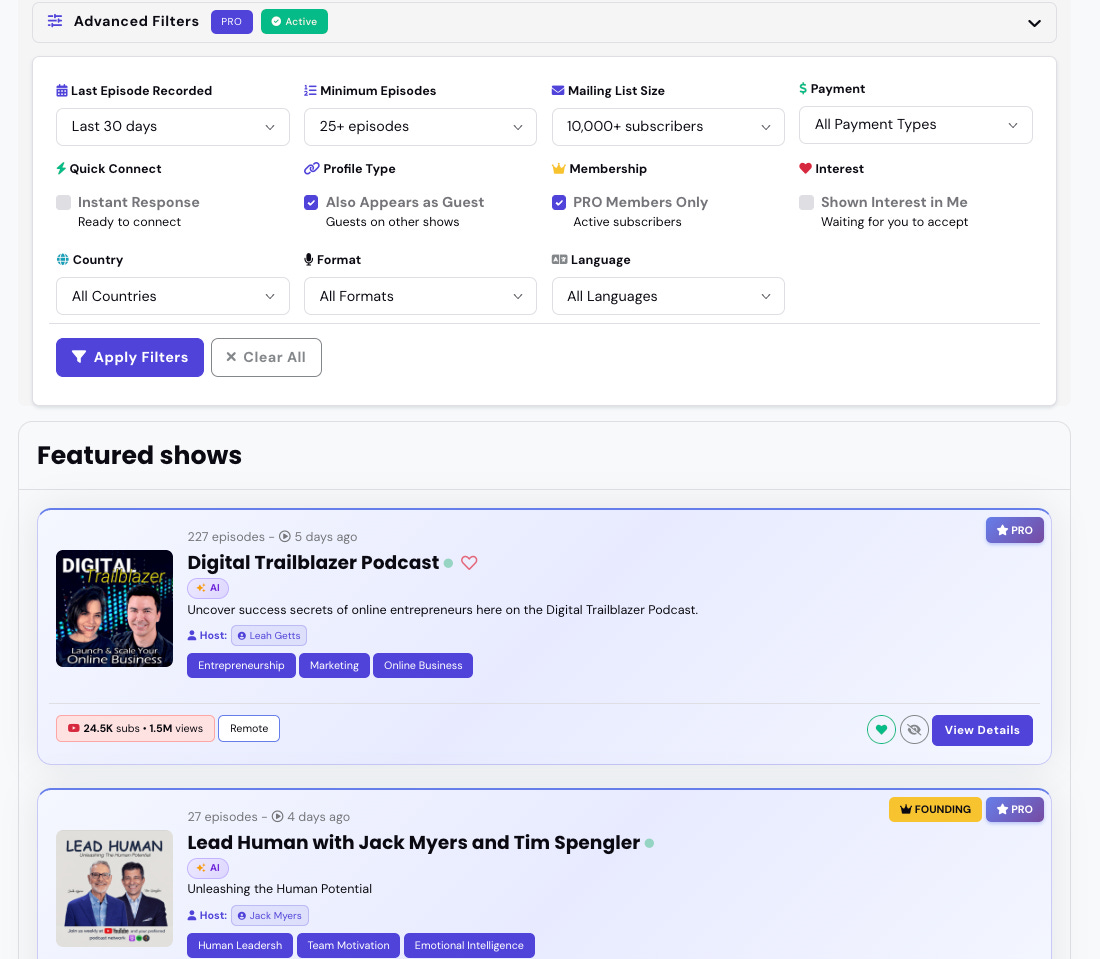
The audience size filter on Talks Pro gives hosts access to actual mailing list size and social following data for guests on the platform. Most hosts use it to set a minimum and stop there.
The guests who use it most effectively use it to understand what a specific audience size tells them about the guest, the quality of the connection request that would follow, and the downstream value of the episode if it gets recorded.
Four things the audience size data tells you that raw outreach research cannot.
1. 🎯 How selective the podcast guest is likely to be about where they appear

A guest with a 50,000 person email list has built that list by appearing consistently in the right places. They are more selective about where they appear than a guest with 500 followers, which means they evaluate your show more carefully before accepting.
What this means for your profile quality: A podcast guest with a large, engaged audience will look at your show description, your past episodes, and your review profile before they decide whether to connect. A show profile that is incomplete or vague loses that guest before the conversation starts.
What it means for the quality of the episode: A guest who is selective about where they appear is a guest who shows up prepared, promotes the episode to their own audience, and treats the appearance as a genuine collaboration rather than a content checkbox.
What it means for your filter strategy: Setting a minimum audience size raises the quality bar for incoming connections but also raises the bar for your own show profile; the filter works both ways.
2. 📈 What the downstream value of the episode is likely to be

A podcast guest with a larger, more engaged audience produces more downstream value from a single episode than a podcast guest with a smaller following, assuming the niche alignment is genuinely strong.
What downstream value includes: The traffic the guest sends to the episode from their own promotion, the new listeners who discover the show through the guest’s audience, the potential for cross-promotion and future collaboration, and the social proof the guest’s name adds to your show’s track record.
What this means for your connection priorities: When you have 30 monthly connections to allocate, prioritizing connections with guests whose audience size produces meaningful downstream value is a better use of those connections than distributing them evenly across all match quality levels.
The niche caveat: A guest with a 1,000 person email list in your exact niche often produces more downstream value than a guest with 50,000 general followers. Audience size without niche alignment is a number, not an opportunity.
3. 🔍 Whether the podcast guest’s reach matches your show’s current stage
Audience size matching works in both directions.
A podcast guest with an audience significantly larger than your show’s current reach can be difficult to attract and difficult to retain as a regular guest type.
A podcast guest whose audience size matches or slightly exceeds your show’s reach is a more realistic connection at your current stage.
What stage-matching produces: More accepted connections, more completed recordings, and more mutual promotion because the collaboration feels genuinely reciprocal rather than one-sided.
What mismatched stage produces: Low acceptance rates from high-reach guests who don’t see the value in appearing, and low downstream value from low-reach guests who don’t move the needle for your show’s growth.
How to calibrate your filter: Look at the audience size of guests you’ve already successfully recorded with and use that range as your starting point rather than setting an aspirational minimum that your show’s current track record doesn’t support.
4. 💡 How seriously the guest treats podcast appearances
Audience size correlates imperfectly but meaningfully with how seriously a guest treats the podcast guesting process.
What serious guests do: They research the show before appearing, prepare talking points, promote the episode after it airs, and leave reviews for the host. These behaviors are more common in guests who have built audiences through consistent value delivery.
What less serious guests do: They show up with minimal preparation, give generic answers, and treat the appearance as a one-directional transaction. These behaviors are more common in guests who are in the early stages of building their platform.
Why this matters for calendar filling: A serious guest takes less host management time before, during, and after the recording. A host who books more serious guests has more time for the work of running the show.
Publishing Frequency Filter: The Signal Most Hosts Miss
Publishing frequency is the filter that tells you how hungry a podcast host is for podcast guests and, from a guest’s perspective, whether the show is actively running.
From the host’s perspective using it to evaluate guest profiles, publishing frequency tells you something different: whether the guest you’re considering is actively promoting their appearances and whether they have a publishing cadence that signals consistent platform engagement.
Two things publishing frequency data tells you about guests on Talks.
1. 📅 Whether the guest is actively engaged with podcasting right now
A podcast guest who has appeared on multiple shows recently and has a publishing cadence of regular appearances is a guest who is actively pursuing podcast guesting as a visibility strategy.
What active engagement means for your show: A guest who is actively guesting treats each appearance as part of a larger strategy. They promote consistently, follow through reliably, and bring the energy of someone who understands the value of what you’re offering them.
What low recent activity signals: Not necessarily that the guest is a poor fit, but that they may not be in an active guesting phase. It’s worth knowing before you invest a connection request in a conversation that may not convert to a scheduled recording.
2. 🔄 Whether the guest’s recent appearances align with your show’s topic
A podcast guest whose recent podcast appearances are concentrated in shows that cover topics adjacent to yours is a guest who is actively positioning themselves in your space.
What concentrated recent appearances signal: That the guest’s current focus is aligned with your show’s topic area and that they have a current angle rather than a general one. A guest with a current specific angle produces a more focused episode than a guest whose recent appearances span six unrelated categories.
What scattered recent podcast appearances signal: That the guest is pitching broadly rather than specifically. Not a disqualifier but worth noting when you’re comparing podcast guests for the same recording slot.
How to Combine Both Filters for the Best Results
The audience size filter and the publishing frequency filter work better in combination than either does alone.
Three filter combinations worth running for different calendar-filling goals.
For filling slots quickly: Recently active guests with audience sizes that match your show’s current stage. This combination surfaces guests who are ready to move and whose connection requests are likely to convert to scheduled recordings within 1 to 2 weeks.
For building show credibility: Guests with larger, more engaged audiences who have published consistently in your topic area recently. This combination surfaces higher-caliber guests whose appearances add social proof to your show’s track record. Takes longer to convert but produces stronger downstream value.
For finding reciprocal promotion partners: Guests whose audience size and topic focus closely match your own show’s audience. This combination surfaces guests for whom the collaboration is genuinely mutually beneficial and who are most likely to promote the episode actively to their own audience after recording.
💡 The two filters covered in this post are Pro features.
The practical translation for hosts trying to fill a recording calendar: a free show profile produces matches from the algorithm based on topic alignment alone.
A Pro show profile with audience size and publishing frequency filters applied produces matches from a pool that has already been filtered for the criteria that most directly predict episode quality and downstream value.
The filter is the difference between a list of available guests and a list of fitting ones.
The Filter Audit Worth Running Before Your Next 30 Connections
Before you send your next batch of connection requests on Talks, run a filtered search with the combination that matches your current calendar-filling goal.
Look at the first 10 results. For each profile ask 2 questions.
Does this guest’s audience size match the stage my show is at and the downstream value I’m trying to produce from this episode?
And does their recent publishing activity suggest they’re actively pursuing appearances in my show’s topic area right now?
A yes to both means send the connection. A no to either means use the filters to find a better match before investing a connection request in a conversation that starts with a lower probability of producing a great episode.
30 connections a month is a meaningful resource. The filters are how you allocate them toward the outcomes that compound rather than the ones that just fill slots.
This is Part 2 of a 5-part series on filling your recording calendar in 30 days using Talks.
The full series:
✅ Part 1: Creating a show profile that attracts more guest applications and matches
✅ Part 2 (you’re here): Using audience size and publishing frequency filters to find better-fit guests faster
Part 3: Managing multiple guest conversations without losing momentum
Part 4: Building a guest pipeline that keeps your recording calendar consistently full
Part 5: Creating a long-term booking system that compounds month after month
🔖 Save this post before you open your search filters on Talks. The 3 filter combinations above are worth having as a reference when you’re deciding which combination matches your current calendar-filling goal.
P.S. The audience size filter gives you access to actual mailing list and social following data for guests on the platform. Most hosts set a minimum and stop there.
The hosts who get the most out of the filter use the number to understand four things: how selective the guest is likely to be, what the downstream value of the episode is, whether the guest’s reach matches the show’s current stage, and how seriously the guest treats podcast appearances.
The number is the starting point. Those four questions are what make it useful. 👇
Keep Talking,
Liam
~
Visibility systems to grow your personal brand, audience + authority with guest appearances. First online sale in 2001. Built multiple 6–7 figure online businesses. 400+ interviews. Malta, Stockholm, Sydney. Love soccer, surf & burritos.