
The Show Profile That Makes Guests Come to You
How to build a Talks show profile that attracts quality guest applications and matches without spending hours on manual outreach every week

Most podcast hosts spend more time finding guests than recording with them.
The research. The cold outreach. The follow-up messages. The scheduling back-and-forth.
Those weeks where the calendar looks empty and the solution seems to be doing more of the same thing that produced the empty calendar in the first place?
There’s a different relationship with guest acquisition available to hosts who build their show profile deliberately.
It doesn’t eliminate the work of booking entirely BUT it does shift the ratio between active effort and passive inbound dramatically.
A well-built Talks show profile attracts guests who are actively looking for a host in your space. It tells them what your show is about, who your audience is, and what appearing on it produces for a guest who fits.
It does that work continuously, for every potential guest who searches your topic or receives your show as a suggested match, without requiring you to initiate contact with each one individually.
30 days of consistent bookings starts with a profile that does the initial qualification work for you.
Why Most Podcast Show Profiles Don’t Attract Quality Guests
A show profile that doesn’t attract quality guests almost always has the same problem.
It was written for listeners rather than guests.
A podcast listener wants to know what the show covers, who the host is, and whether the content is worth their time.
A podcast guest wants to know something different: whether their expertise is the right fit, whether the show’s audience matches the people they’re trying to reach, and whether appearing will produce something worth the time investment of preparing and recording.
Most show profiles answer the listener’s questions and leave the guest’s questions unanswered. The result is a profile that describes the show accurately and attracts guests who are a poor fit, because the guests who are a good fit couldn’t tell from the profile that they were.
A show profile built to attract quality guests answers the guest’s questions before they have to ask them.
6 Elements That Determine Whether Your Show Profile Attracts Quality Guests 🛠️
6 elements on your Talks show profile determine whether guests who find it self-select correctly or whether you spend your time managing inquiries that don’t convert to good episodes.
1. 🏷️ Your show username: Permanent, searchable, and brandable

Your username becomes your permanent show profile URL, for example talks.co/yourshowname, and it affects both your Google ranking and the first impression guests form when they look you up.
What a deliberate username choice produces: A URL that accumulates Google authority with every backlink it receives from episode show notes, social profiles, and website pages. www.talks.co/themindshiftpodcast/ ranks for that show name and builds recognition alongside it.
What a generic username costs: A URL that doesn’t represent the show, doesn’t rank for the show name, and doesn’t benefit from the distribution the show generates over time.
The constraint worth respecting: Changing the username later resets the search ranking that has accumulated and breaks every link already shared. Choose it with the knowledge that it’s permanent and commit.
2. 📝 Your show description: Written for guests, not listeners
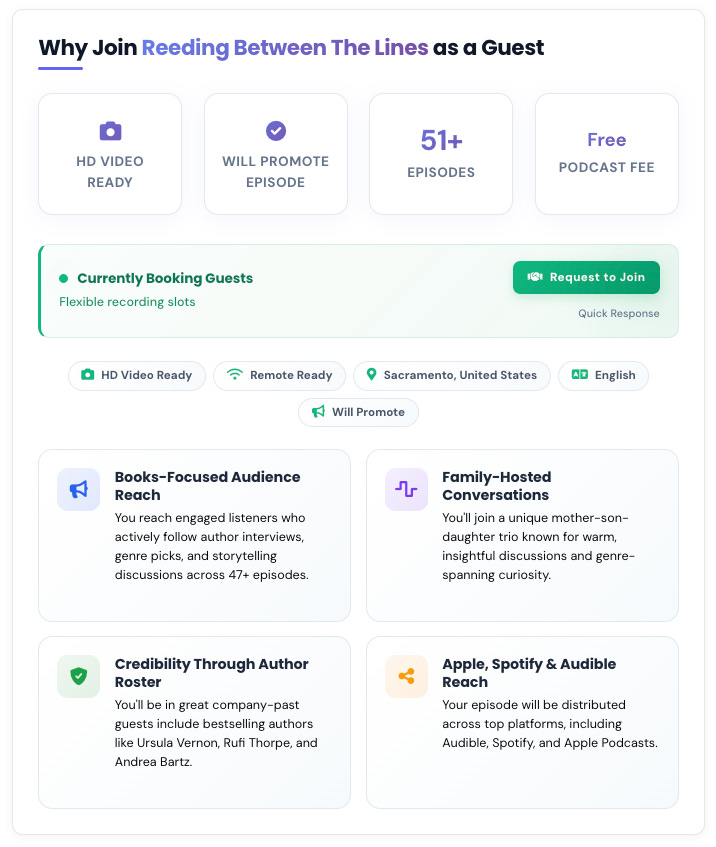
The show description is the first thing a potential guest reads after the show name. It answers the question they’re actually asking: “Is my expertise right for this show and its audience?”
What a guest-focused description includes: The show’s core topic, the specific type of audience it serves, the format and tone of conversations, and what a guest appearance on the show typically produces for the guest in terms of exposure and audience reach.
What a listener-focused description includes: What the show covers, why it’s worth listening to, and how often new episodes are released. Useful for listeners, insufficient for guests making a booking decision.
The sentence worth adding that most show descriptions don’t have: One line that explicitly describes the type of guest who fits the show; “we feature coaches and consultants who have built their practice without relying on referrals or paid advertising” tells the right guest they’re in the right place and tells the wrong guest to move on.
3. 🎯 Your guest topics: Specific enough to filter, broad enough to attract
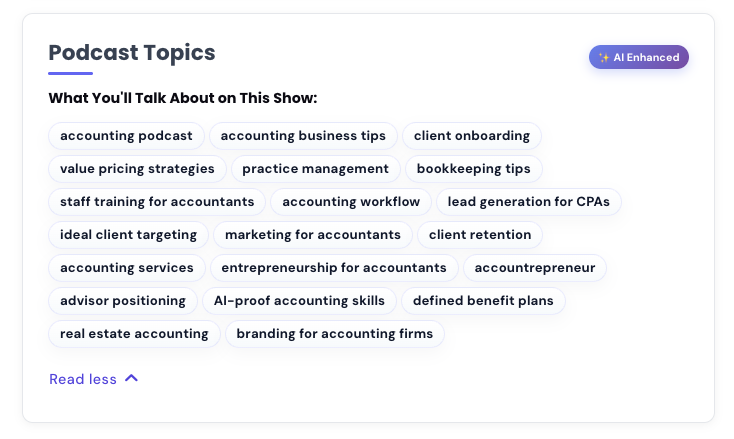
Podcast guest topics on your show profile are the primary signal the Talks algorithm uses to match you with relevant guests. They’re also what a potential guest reads to assess whether their expertise is a fit.
What too broad looks like: “Business, leadership, entrepreneurship, personal development”. Every show in the coaching and consulting space uses these topics. They produce matches with every guest in those categories and filter for none of them.
What too narrow looks like: A list so specific that only two or three guests in the world would qualify. Useful for filtering but it limits the volume of matches the algorithm can generate.
What the right specificity looks like: Topics specific enough to attract guests whose expertise genuinely fits the show’s audience and broad enough to produce a meaningful pool of matches. “Building a coaching practice without paid advertising,” “pricing strategy for service-based businesses,” and “client retention for coaches and consultants” are specific enough to filter and broad enough to attract.
4. 🎙️ Your published episodes: Social proof that converts guest interest into connection requests
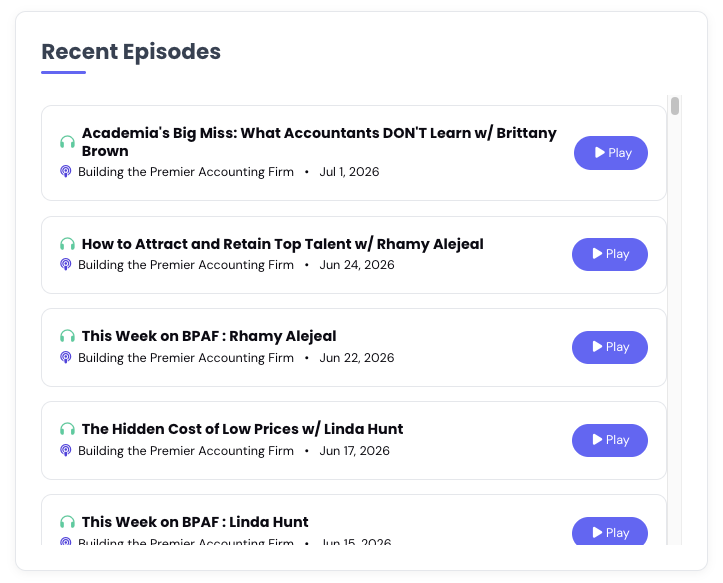
A potential guest who can listen to a past episode before deciding whether to connect makes a better-informed decision and arrives at the connection with more confidence in the fit.
What published episodes do for guest attraction: They show a potential guest exactly what the conversation style, depth, and audience experience of your show looks and sounds like before they commit to appearing. A podcast guest who listens to an episode and thinks that’s the kind of conversation I could deliver is a guest who sends a connection request.
What to include for each episode: The episode title, the guest name, a one-line description of what the conversation covered, and a live link to wherever the episode is published.
What the accumulation of episodes produces over time: A visible track record that makes your show progressively more attractive to higher-caliber guests. A show with 50 published episodes and strong reviews is a different proposition than a show with 5.
5. ❓ Your guest application questions: Filter quality before you spend time on it
The guest application or connection request process on Talks gives hosts the ability to see enough about a potential guest to make a qualification decision before a conversation opens.
What a well-built qualification process does: Surfaces the information you need to decide whether a guest is worth a recording conversation before you’ve invested time in a scheduling back-and-forth that goes nowhere.
What to look for in a guest profile before accepting a connection: Their suggested interview topics, their past appearances, their video pitch if they have one, and their review profile from previous hosts. Together these 4 elements tell you more about fit and reliability than any pitch email ever does.
The time this saves: A host who qualifies guests through profile evaluation before accepting connections spends zero time on scheduling conversations with guests who turn out to be wrong fits. That time goes back to the actual work of running the show.
6. 🔗 Your show profile URL: Distributed across every relevant surface

A show profile that exists only inside Talks attracts only the guests who are already on Talks and already searching for shows in your space. A show profile URL distributed across every relevant surface attracts guests from every platform where they might encounter it.
Where to distribute your show profile URL: Your podcast website’s guest application page, your social bios, your email signature, the show notes of every episode, and any content you publish where potential guests might find it.
What each placement produces: A separate source of inbound guest interest that feeds into the same profile qualification process. A host who has distributed their profile URL across five platforms has five separate streams of potential guest discovery feeding one qualification system.
The compounding effect: Every episode that goes live and links to your show profile in its show notes is a permanent backlink that strengthens your Google ranking. A show with one hundred episodes has one hundred backlinks building search authority for the show profile URL continuously.
The Guest-Perspective Audit Worth Doing Before You Activate Anything Else 🔑
Read your current show profile as if you’re a potential guest who has just found it for the first time.
You know your expertise. You know what kind of shows fit your positioning. You’re looking at this profile to decide whether to send a connection request.
Five questions worth answering from that perspective.
Can you tell within 10 seconds whether your expertise is right for this show? If no, the description needs to be more specific about the type of guest who fits
Can you picture the kind of conversation you’d have on this show? If no, the published episodes section needs content that demonstrates the show’s style and depth
Can you tell who the show’s audience is and whether they match the people you’re trying to reach? If no, the description needs to name the audience more specifically
Would you feel confident that your connection request would be well-received? If no, something about the profile is creating uncertainty rather than invitation
Is there a clear next step that tells you what to do if you want to apply? If no, the profile needs a more explicit invitation to connect
Every no is a guest who found your show, assessed the profile, and decided not to send a connection request. Fix the nos before you activate the matching system and start generating inbound interest.
💡 A show profile built to answer a guest’s questions rather than a listener’s questions does something a listener-focused profile cannot: it filters quality in rather than just describing the show accurately.
The guests who connect after reading a well-built guest-focused profile are the guests who already know they’re a fit. Those conversations move faster, schedule easier, and produce better episodes than connections built on uncertainty about whether the fit is actually there.
This is Part 1 of a 5-part series on filling your recording calendar in 30 days using Talks.co.
The full series:
✅ Part 1 (you’re here): Creating a show profile that attracts more guest applications and matches
Part 2: Using audience size and publishing frequency filters to find better-fit guests faster
Part 3: Managing multiple guest conversations without losing momentum
Part 4: Building a guest pipeline that keeps your recording calendar consistently full
Part 5: Creating a long-term booking system that compounds month after month
🔖 Save this post before you open your Talks show profile settings. The six elements above and the five-question guest-perspective audit are worth working through before you activate the matching system so that the guests it surfaces are finding a profile worth connecting with.
P.S. The single most useful thing you can add to a show profile that most hosts leave out: one sentence that explicitly describes the type of guest who fits the show. “We feature coaches and consultants who have built their practice without relying on referrals or paid advertising” tells the right guest they’re in the right place and tells the wrong guest to move on before either of you invests time in a conversation that wasn’t going to work. Add that sentence before you do anything else. 👇
Keep Talking,
Liam
~
Visibility systems to grow your personal brand, audience + authority with guest appearances. First online sale in 2001. Built multiple 6–7 figure online businesses. 400+ interviews. Malta, Stockholm, Sydney. Love soccer, surf & burritos.