
The 60-Second Asset That Converts Profile Visitors Into Booking Conversations
How to optimize your Talks video pitch to build trust faster, remove booking hesitation, and turn profile browsers into hosts who reach out

Every host who finds your profile is carrying a question they won’t ask directly.
Will this guest actually be good on mic?
A written profile answers almost everything else from topic fit and credibility to past appearances and suggested questions. All of it readable, assessable, useful.
But the question a host is really asking before they commit to giving a guest an hour of their audience’s attention isn’t answered by any of it.
Presence isn’t describable. Energy isn’t quotable.
Whether a conversation with you will actually be worth recording isn’t something a bio can demonstrate.
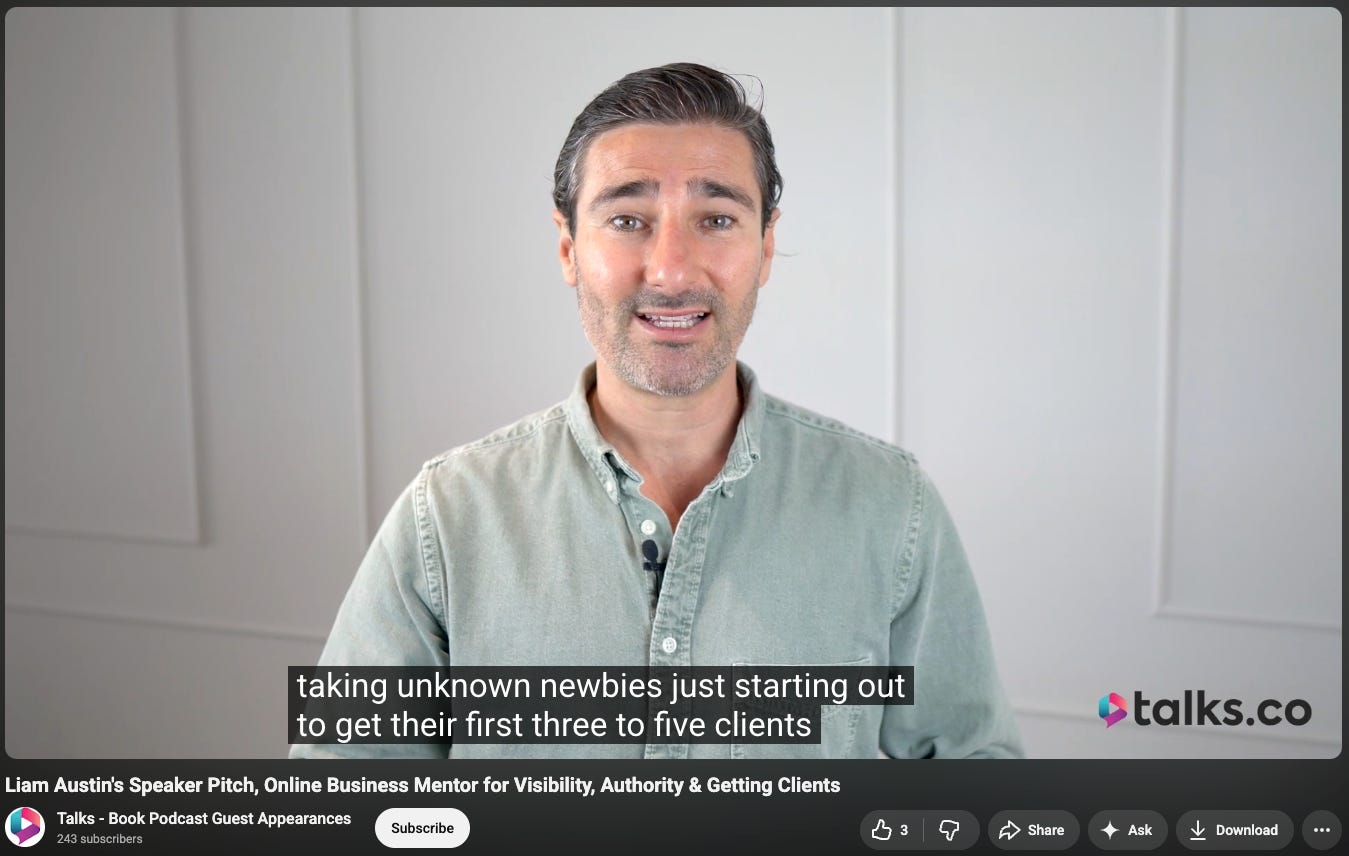
A 60-second video does what no written profile element can. It answers the host’s most important unspoken question before the question becomes a reason to hesitate.
And it does it without you being present.
What a Video Pitch Actually Does for a Passive Profile
Most guests think of the video pitch as a nice addition to a complete profile.
In the context of a profile built to work passively, it’s the element that closes the gap between a host who is interested and a host who reaches out.
Three things happen when a host watches your video pitch that cannot happen any other way.
They hear how you actually sound: Not how you describe your voice or characterize your style but how you actually speak, pace yourself, and hold a listener’s attention across 60 seconds of unscripted delivery.
They feel whether you’re genuine: A written bio can be crafted to project any quality; sixty seconds of video is substantially harder to fake. A host who watches your pitch knows quickly whether the warmth and confidence in your written profile reflects how you actually show up.
They make a decision faster: Uncertainty delays booking decisions but the video pitch removes the specific uncertainty that written profiles cannot resolve. Hosts who feel confident about a guest’s presence reach out sooner and with fewer preliminary questions.
A profile with a video pitch converts browsers into connection requests at a higher rate than a profile without one.
The profile without one asks the host to take a leap of faith on the presence question. The profile with one answers it.
5 Elements of a Video Pitch That Converts
Most guests who record a video pitch make one of two mistakes. They over-produce it until it feels like a commercial. Or they under-prepare it until it feels like an audition that didn’t go well.
Neither version answers the host’s question. A commercial feels like a performance. An unprepared pitch signals the guest doesn’t take this seriously enough to prepare.
The version that converts feels like the first thirty seconds of a real conversation with someone who knows exactly what they do and why it matters to the host watching.
Five elements make that version possible.
1. 🏷️ Open with who you help, not who you are

The first 5 seconds determine whether the host keeps watching. A host who hears their audience described in the opening line keeps watching. A host who hears a name and a job title makes a faster decision about whether to continue.
What opening with who you help looks like: “If you host a show for coaches or consultants who are trying to grow their client base, I’d love to talk about being a guest.”
What opening with who you are looks like: “Hi, I’m [name] and I’m a business coach with fifteen years of experience.”
Why the distinction matters at the passive profile stage: A host browsing profiles is making rapid decisions about relevance before they slow down to evaluate quality and the opening line is the relevance filter. Pass it and they keep watching; fail it and they move on regardless of what follows.
2. 📌 Name your specific topic in one sentence
After the relevance filter, the host needs to know immediately what the conversation would actually be about.
What specific looks like: “I specifically cover the pricing conversation most coaches avoid, and in my experience that conversation is the one that changes everything about how fast a coaching business grows.”
What vague looks like: “I talk about business growth, mindset, and helping coaches reach their potential.”
The test: after hearing your topic sentence, could a host describe the episode you’d deliver to someone else in one sentence? If yes the communication worked. If no it needs more specificity.
3. 🎯 Name one concrete thing the host’s audience will walk away with
This is the sentence that moves a host from evaluating whether to book you to imagining the episode already produced.
What concrete looks like: “By the end of the episode your listeners will have a specific framework for setting their first premium price that accounts for where they are right now in their business, not where a generic pricing guide assumes they should be.”
What abstract looks like: “Your listeners will leave feeling inspired and with a new perspective on their business.”
Why concrete converts and abstract doesn’t: A host can picture an episode built around a specific framework. A host cannot picture an episode built around inspiration; the picture is what produces the connection request.
4. 🤝 End with a low-friction invitation
The close of the video pitch should make the next step feel easy rather than pressured.
What low-friction looks like: “If this sounds like a fit for your audience I’d love to connect and explore what an episode could look like.”
What high-friction looks like: “I’m available the second and fourth week of next month and I’d love to get something on the calendar.”
Why the distinction matters: A host who feels invited responds whereas a host who feels managed resists. So the video pitch is the beginning of a relationship, not the close of a sale.
5. ✂️ Stop at 60 seconds
Not 65. Not 90 because you had more to say.
60.
What the 60-second constraint forces: The clarity that makes the pitch work where very element that can be cut without losing a necessary piece of information gets cut and what remains is the version that respects the host’s time and signals that you understand what they’re evaluating.
What running over communicates: That you either didn’t prepare enough to know what to cut or didn’t respect the host’s time enough to cut it. Neither impression serves the passive profile goal.
How to get there: Write a loose outline, record it, time it, cut until it fits. Most people find the 60-second version somewhere between the third and seventh take.
How to Record It Without It Feeling “Produced” 📹

The production quality that works for a video pitch is the production quality of a professional video call. Nothing more. Nothing less.
Background: Clean and uncluttered or something that communicates professional context without requiring explanation or drawing attention
Lighting: A window in front of you or a ring light behind your camera; enough light that your face is clearly visible without harsh shadows
Audio: A headset with a built-in microphone or an external microphone (anything that produces clear, echo-free audio). Laptop microphones in reverberant rooms are the most common reason video pitches underperform relative to the written profile they’re attached to.
Delivery: Conversational rather than performed. The tone of voice you’d use in the first minute of a real call with someone you’re genuinely interested in working with, not rehearsed to the point of sounding scripted or improvised to the point of sounding unprepared.
Number of takes: Enough to get one where you sound like yourself. Most people land on that take somewhere between 3 and 8. If it still feels performed at take fifteen the script needs revision rather than the delivery.
💡 The video pitch is exclusive to Pro members on Talks. It’s also the feature that most directly answers the question every host is asking but never saying out loud. A profile with a video pitch removes the specific uncertainty that written profiles cannot resolve.
In a passive profile context where hosts are making rapid decisions from search results and match suggestions, that uncertainty removal is what converts a profile view into a connection request. It’s the asset that works while you sleep.
The Optimization Worth Doing After the First Version Is Live
Recording the first version is the important step. Optimizing it is the step that compounds.
A video pitch recorded when your profile had 5 completed interviews should be updated when your profile has 20. The confidence, the track record reference, and the specificity of what you offer all evolve as your guesting history builds.
Three signals tell you the current version needs updating.
Your acceptance rate has changed significantly: A higher acceptance rate suggests the profile is converting well and the video pitch is contributing while a lower acceptance rate despite strong written content suggests the video pitch may be the element creating friction.
Your positioning has shifted: If the specific topic, audience, or outcome you cover has evolved since you recorded the pitch, the pitch is sending hosts a signal that no longer matches what they’ll find when they actually talk to you.
Your track record has grown substantially: A video pitch that references “I’d love to be a guest on your show” lands differently when the profile it’s attached to has 30 completed interviews versus 2. The pitch should reflect the authority the rest of the profile has accumulated.
Record it once. Let it work. Update it when the profile it represents has grown past it.
This is Part 4 of a 5-part series on building a Talks.co profile that works while you sleep.
The full series:
✅ Part 1: Building a Talks profile that attracts opportunities automatically
✅ Part 2: Using auto-accept matches and auto-responses to save time and increase activity
✅ Part 3: Setting up lead magnets that capture subscribers from every appearance
✅ Part 4 (you’re here): Optimizing your video pitch to build trust and improve conversion rates
Part 5: Using the Talks affiliate program to create an additional revenue stream while you grow
🔖 Save this post before you record your video pitch. The five-element structure above is the outline worth having open while you record rather than something to review afterward.
P.S. The most common video pitch mistake isn’t poor production quality or awkward delivery. It’s opening with a name and job title instead of with who you help and what you help them do. A host watching five profiles in a row remembers the ones that immediately told them whether the guest was relevant. Open with relevance. Everything else follows from that. 👇
Keep Talking,
Liam
~
Visibility systems to grow your personal brand, audience + authority with guest appearances. First online sale in 2001. Built multiple 6–7 figure online businesses. 400+ interviews. Malta, Stockholm, Sydney. Love soccer, surf & burritos.