
The Talks Profile That Attracts Opportunities While You’re Doing Everything Else
How to build a Talks profile that works as a passive opportunity engine, bringing hosts to you instead of requiring you to chase them

Most podcast guests treat guesting like a second job.
Research shows to pitch and write outreach messages, to follow up on conversations and track who responded and who didn’t just so you can start over next week because the pipeline emptied itself… again.
That model works. It’s just expensive. It costs time, attention, and energy that busy coaches, consultants, and entrepreneurs are already stretched thin on.
There’s a different model. It requires more upfront investment in the profile itself and significantly less ongoing maintenance once that investment is made.
The profile does the work. You show up for the conversations it generates.
The difference between a profile that requires constant effort and a profile that generates passive opportunities is five specific decisions made when the profile is built.
What a Passive Opportunity Profile Is 🎯
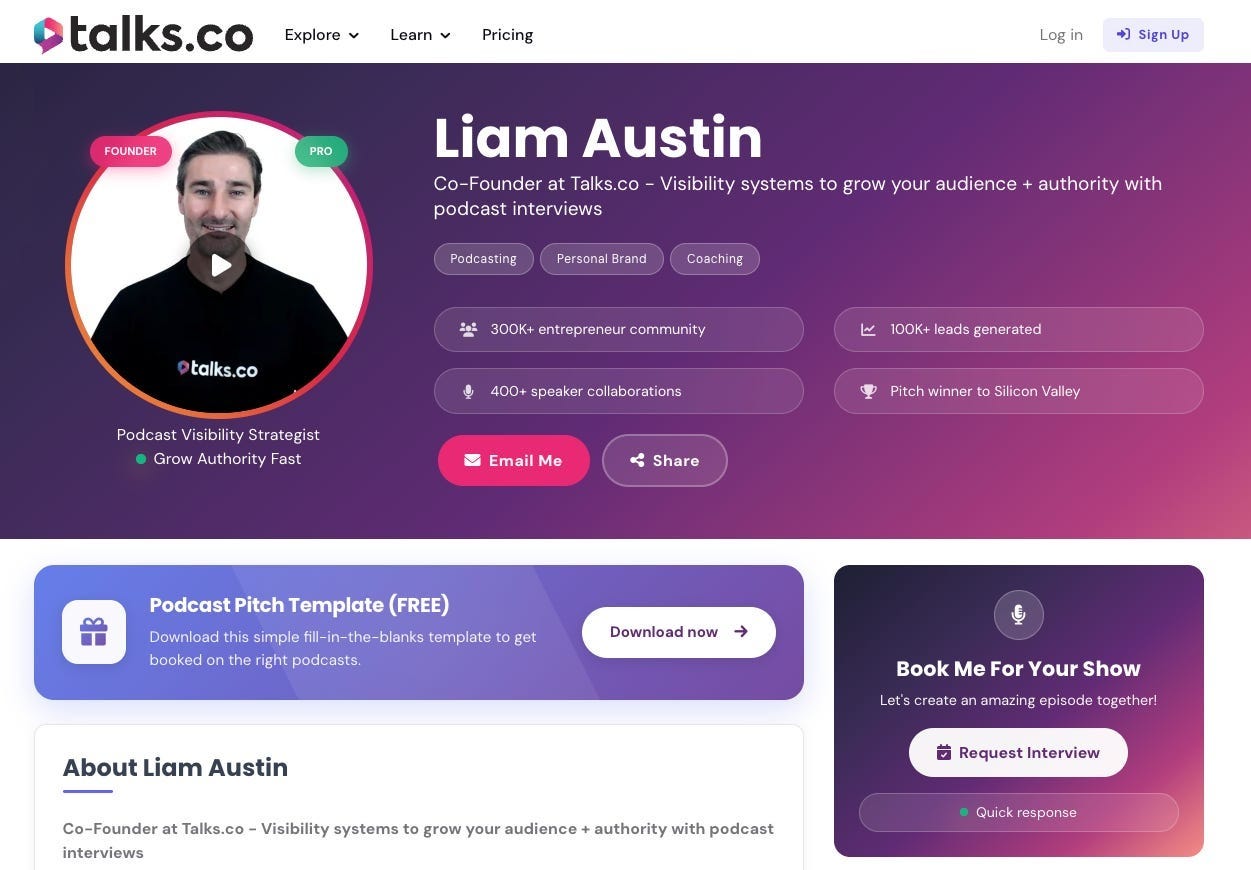
A passive opportunity profile is a profile built to attract rather than chase.
Most profiles are built for the guest’s comfort. They describe what the guest does, list the topics they cover, and wait for hosts to decide whether to reach out.
A passive opportunity profile is built for the host’s decision-making process. Every element answers the question a host is asking at the specific moment they encounter it.
The headline answers the relevance question in the first three seconds.
The topics answer the fit question before the host has to think about it.
The suggested questions answer the preparation question before the host asks.
The video pitch answers the presence question before a call is needed.
A host who lands on a profile built this way moves through their decision faster, with more confidence, and with less friction.
That speed and confidence is what produces connection requests without the guest having to initiate them.
5 Decisions That Determine Whether Your Profile Works Passively… Or Not 🛠️
Each decision has a default version that most guests choose and a deliberate version that produces passive results. The difference between them is smaller than most guests expect and the outcome difference is larger.
1. 🏷️ Your username: permanent, public, and searchable
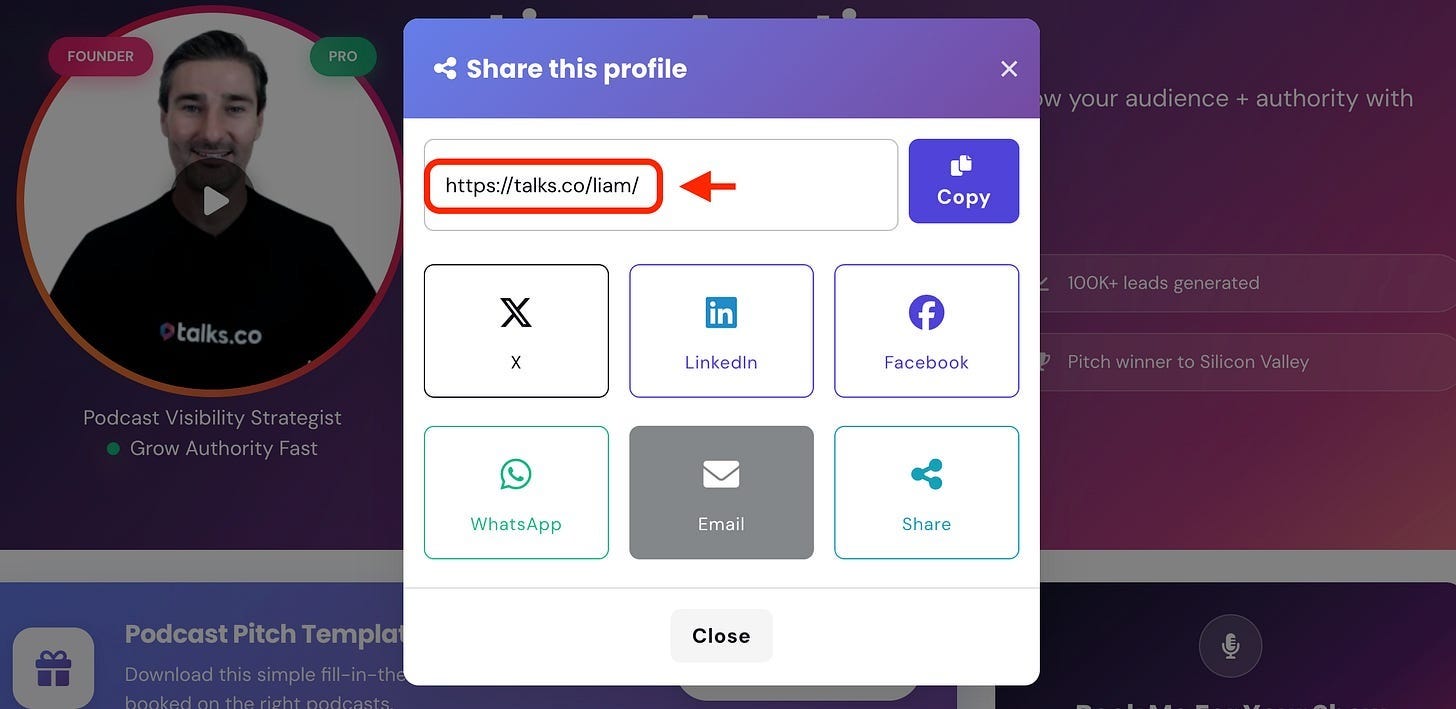
The default version is whatever username was available when the guest signed up.
The deliberate version is your actual name or personal brand name chosen with the knowledge that this URL will be indexed by Google, shared in every show notes page that mentions you, and linked from every social profile that points to your speaker page.
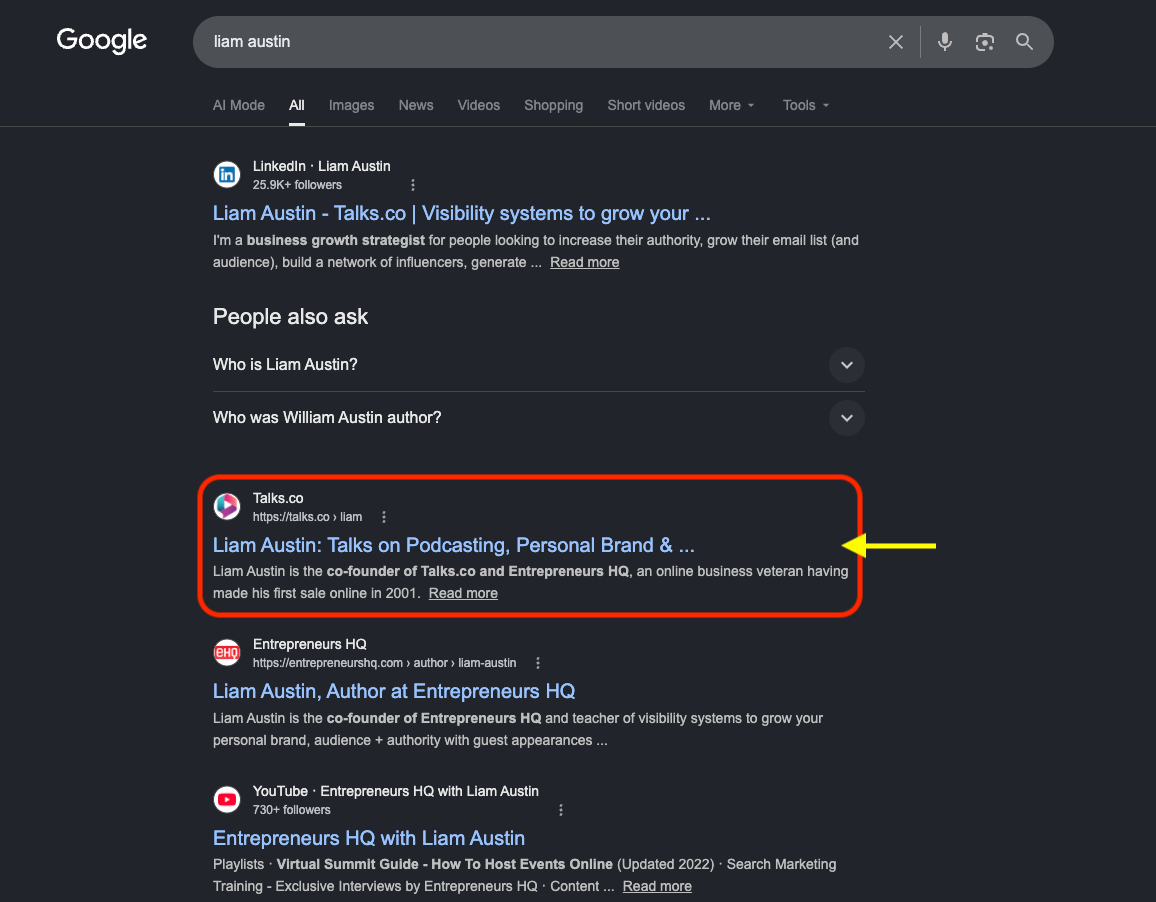
What the deliberate choice produces: A URL that accumulates Google authority with every backlink it receives from episode show notes. talks.co/yourname showing up in Google results for your name is a passive discovery mechanism that operates continuously regardless of your active involvement
What the default choice costs: A URL that doesn’t represent your brand, doesn’t rank for your name, and doesn’t benefit from the backlinks your appearances generate.
Why changing it later is costly: Every link already shared pointing to the old URL breaks when the username changes. Choose once and commit.
2. 📝 Your headline: The 3-second relevance test
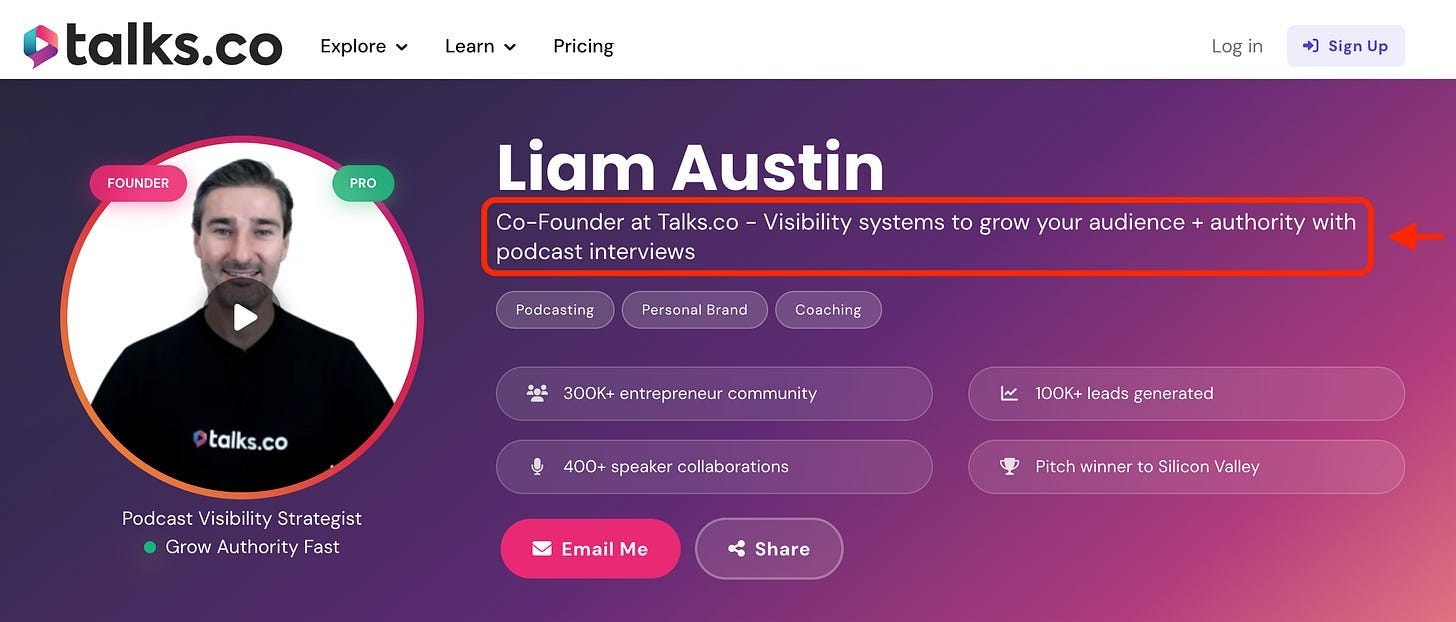
The default version describes a role.
“Business coach.” “Marketing consultant.” “Leadership speaker.”
The deliberate version names an outcome for a specific person. “I help early-stage coaches build their first client pipeline without relying on referrals.”
What the deliberate headline produces: A host who reads it knows within three seconds whether you’re relevant to their show and audience. That instant clarity reduces the cognitive work required to make a booking decision, which makes the decision happen faster.
What the default headline produces: A host who has to keep reading to determine relevance; many don’t.
The test worth applying: Could your headline belong to any guest in your space? If yes it’s describing a category, not a person.
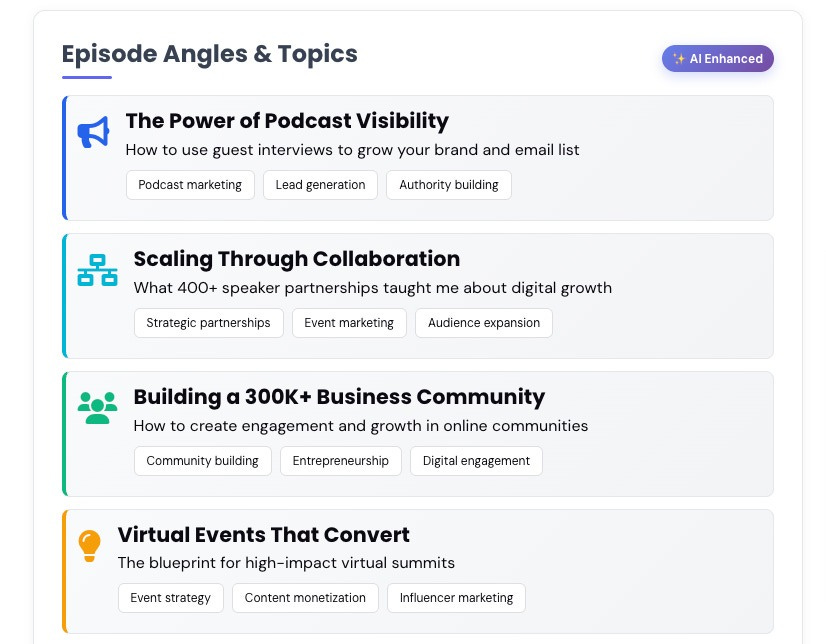
3. 🎯 Your topics: Specific problems rather than general subjects
The default version lists subjects.
“Leadership. Mindset. Business growth. Entrepreneurship.”
The deliberate version names the specific problems you solve or the specific transformations you produce.
What specific topics produce for the algorithm: More accurate matches because the algorithm cross-references your topics against what hosts are actively looking for. A specific topic match is a higher-probability booking opportunity than a general category match.
What specific topics produce for hosts who read them: An immediate mental image of what an episode would look like and who it would help. That image is what converts a browsing host into a connecting host.
The specificity test: If your topic could describe any guest in your general space, it’s not specific enough to do passive work for you.
4. ❓ Your suggested questions: Pre-production done for the host
The default version is empty or generic. “Tell us about your background. What inspired you to start your business.”
The deliberate version is 5 to 7 questions written from the listener’s perspective that a host could use almost word for word.
What listener-perspective questions produce: A host who reads them can immediately picture the episode fully formed. A fully-formed episode picture in a host’s mind is a booking decision that’s already been made.
What they signal beyond content: That you understand how podcasting works, that you’ve thought about the host’s audience rather than your own agenda, and that you’re going to make the pre-production process easier rather than more demanding.
What they produce for the guest: Advance knowledge of the questions most likely to be asked, which means better answers prepared for the conversations your profile generates.
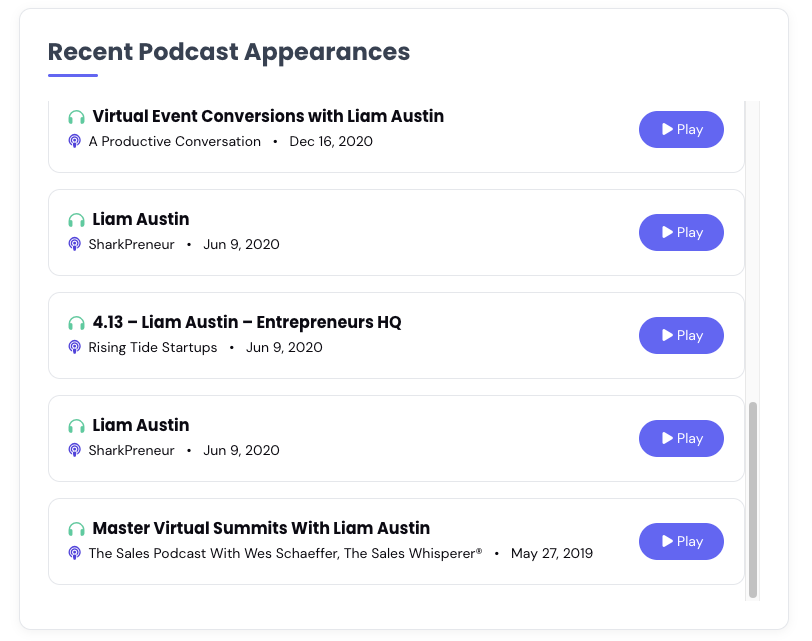
5. 🎙️ Your past appearances: A track record that works while you sleep
The default version lists show names without context.
The deliberate version includes the show name, a one-line description of what the conversation covered, and a live link to the episode.
What context produces: A host who reads your past appearances can evaluate the quality and relevance of your previous interviews without having to search for them; that evaluation is what turns a browsing host into a confident host.
What live links produce: Passive traffic from anyone who finds your profile and follows the links to your previous episodes. That traffic is pre-warmed by your profile before it arrives at the episode.
What the accumulation of appearances produces over time: a track record that gets more compelling with every addition and that works for you continuously as long as the episodes remain live.
5 Steps That Make the Profile Discoverable Beyond Talks 📈
A passive opportunity profile doesn’t just attract hosts inside Talks. It attracts them from every platform where your profile URL appears.
Step 1: Add your Talks profile URL to your LinkedIn website field and name it “Your Name Speaker Profile.”
Step 2: Add it to your Facebook, Instagram, Twitter/X, TikTok, and Linktree bio fields.
Step 3: Add it to your email signature with a line like “Available for podcast interviews.”
Step 4: Add it to your website’s about or speaker page with a “Request an interview” CTA.
Step 5: Add each new episode to your past appearances section immediately after it goes live so every show notes page that links to your profile finds a complete, updated record of your track record.
Every platform that links to your Talks profile is a source of passive discovery. Every episode that goes live and links back to your profile is a backlink that strengthens your Google ranking.
The profile accumulates authority from every direction simultaneously as long as the links are in place.
💡 A passive opportunity profile requires more effort to build than a default one and less effort to maintain. The investment is front-loaded. The returns are ongoing. Most guests get this backwards: they spend minimal effort on the profile and maximum effort on outreach. A deliberate profile flips that ratio and produces compounding results instead of linear ones.
The Shift That Makes Everything Else In This Series Work 🔑
Every other post in this series covers a specific feature that automates or amplifies part of the podcast guesting process: auto-accept matches, auto-responses, lead magnets, video pitches, affiliate income.
All of those features depend on the profile they’re attached to.
An auto-accept match on a weak profile accepts a connection the host will never convert. An auto-response from a profile with a vague headline starts a conversation that goes nowhere. A lead magnet on a profile that nobody finds captures no leads.
The profile is the foundation. Build it deliberately and every automation feature this series covers produces its designed output. Build it by default and the automations have nothing solid to amplify.
Start here. Build this properly. Then let the rest of the series show you what a well-built profile with automation behind it actually produces.
This is Part 1 of a 5-part series on building a Talks.co profile that works while you sleep.
The full series:
✅ Part 1 (you’re here): Building a Talks profile that attracts opportunities automatically
Part 2: Using auto-accept matches and auto-responses to save time and increase activity
Part 3: Setting up lead magnets that capture subscribers from every appearance
Part 4: Optimizing your video pitch to build trust and improve conversion rates
Part 5: Using the Talks affiliate program to create an additional revenue stream while you grow
🔖 Save this post before you open your Talks profile settings. The five decisions above are the ones worth revisiting before you activate any of the automation features covered in the rest of this series.
P.S. The username decision is the one most guests make in 30 seconds without realizing it affects their Google ranking for months afterward. Your Talks profile URL accumulates backlink authority from every episode show notes page that links to it. A URL that represents your name builds that authority under your personal brand. A random username builds it under nothing useful. Two minutes of thought before you hit save. 👇
Keep Talking,
Liam
~
Visibility systems to grow your personal brand, audience + authority with guest appearances. First online sale in 2001. Built multiple 6–7 figure online businesses. 400+ interviews. Malta, Stockholm, Sydney. Love soccer, surf & burritos.