
Stop Pitching Cold. Here’s How to Find Podcast Hosts Who Already Want You.
Why the question of who you pitch matters more than how you pitch, and the tools that make targeted outreach actually scalable

The first two posts in this series were about fixing your pitch and building your credibility page.
This one is about something more fundamental: who you’re pitching in the first place.
Most people approach podcast guesting the same way they approach cold outreach. You build a list, you send messages, you wait, you follow up, you move on. It works eventually, but the conversion rate is brutal and the process is exhausting.
There’s a different way to think about it.
Instead of trying to convince hosts who have no idea who you are, what if you could find hosts who are actively looking for a guest with your exact background, your exact topics, and your exact audience fit?
That’s not a hypothetical. That’s what AI matching actually does when it’s set up properly.
Here’s how the host discovery side of Talks.co works, and why it changes the math on your outreach completely.
The Problem With Manual Research
When you search for podcasts to pitch manually, you’re working with limited signals at every step.
What you can see: Category, episode descriptions, a rough sense of production quality, and maybe a download estimate if you can find one.
What you can’t see: Whether the host is actively booking guests right now, what their actual audience size is, or whether they covered your exact topic three times last quarter.
What this costs you: Somewhere between 20 and 30 minutes per show in research time, at the end of which you still don’t have a confident answer on fit.
You end up with a list that feels solid but has a lot of hidden mismatches buried inside it.
And when those mismatches reveal themselves through silence or polite rejections, it’s demoralizing in a way that makes people quit the strategy entirely before it has a chance to work.
What the Talks Matching Algorithm Does Differently
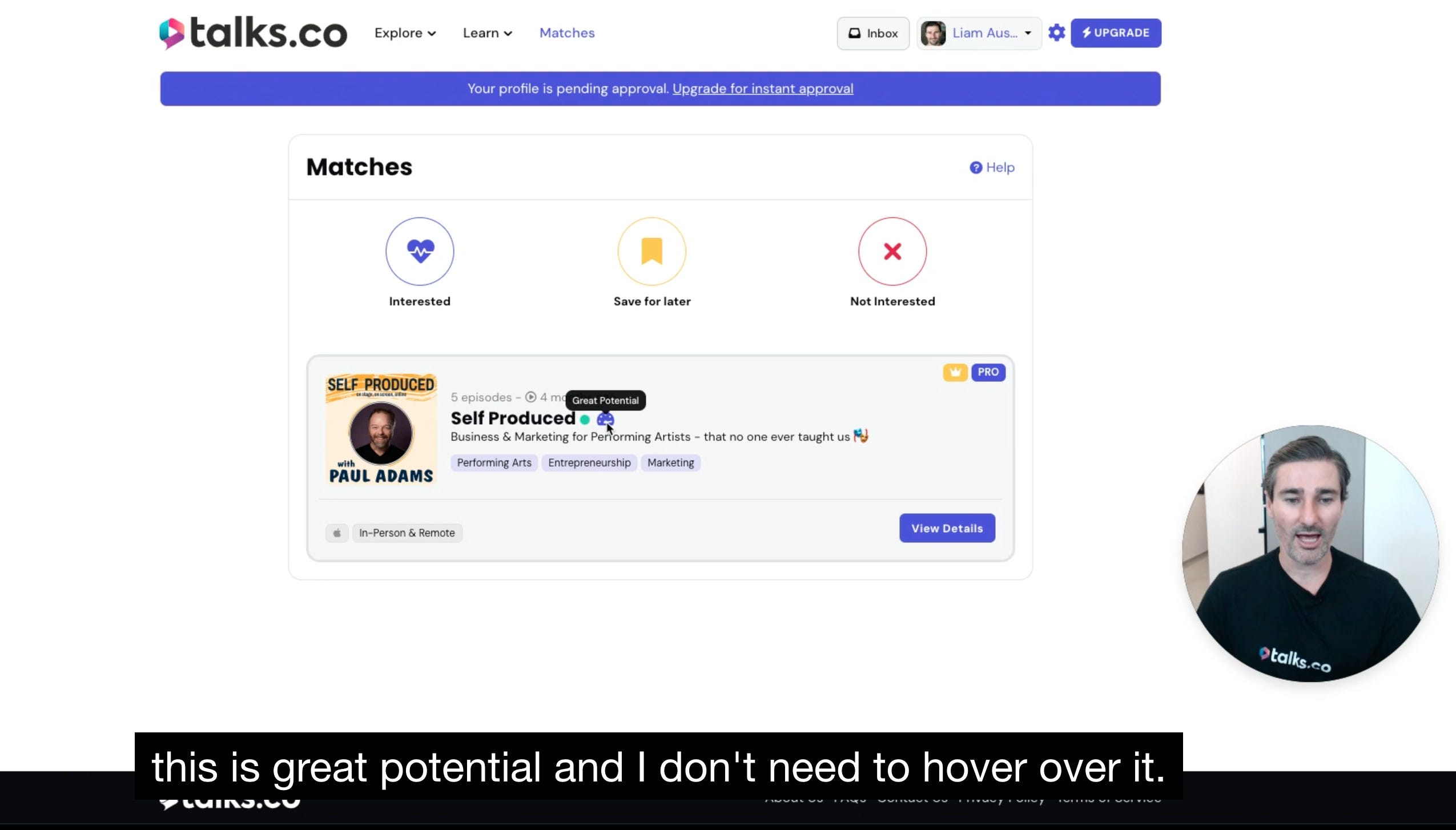
Talks matches your profile against shows based on a combination of signals that manual research can’t replicate at speed.
What it looks at: Your niche, your topics, your keywords, your audience type, and your speaking angle, all at once.
What that produces: A list of shows where the probability of a yes is genuinely higher, because you’re not just in the right category; you’re the right kind of guest for that specific show.
Why that difference matters: Category overlap gets you in the right neighborhood. Multi-dimensional matching gets you in the right room.
The practical result is that you spend less time researching and more time having actual conversations with hosts who had a reason to be interested before you even sent a word.
The Filters That Actually Matter
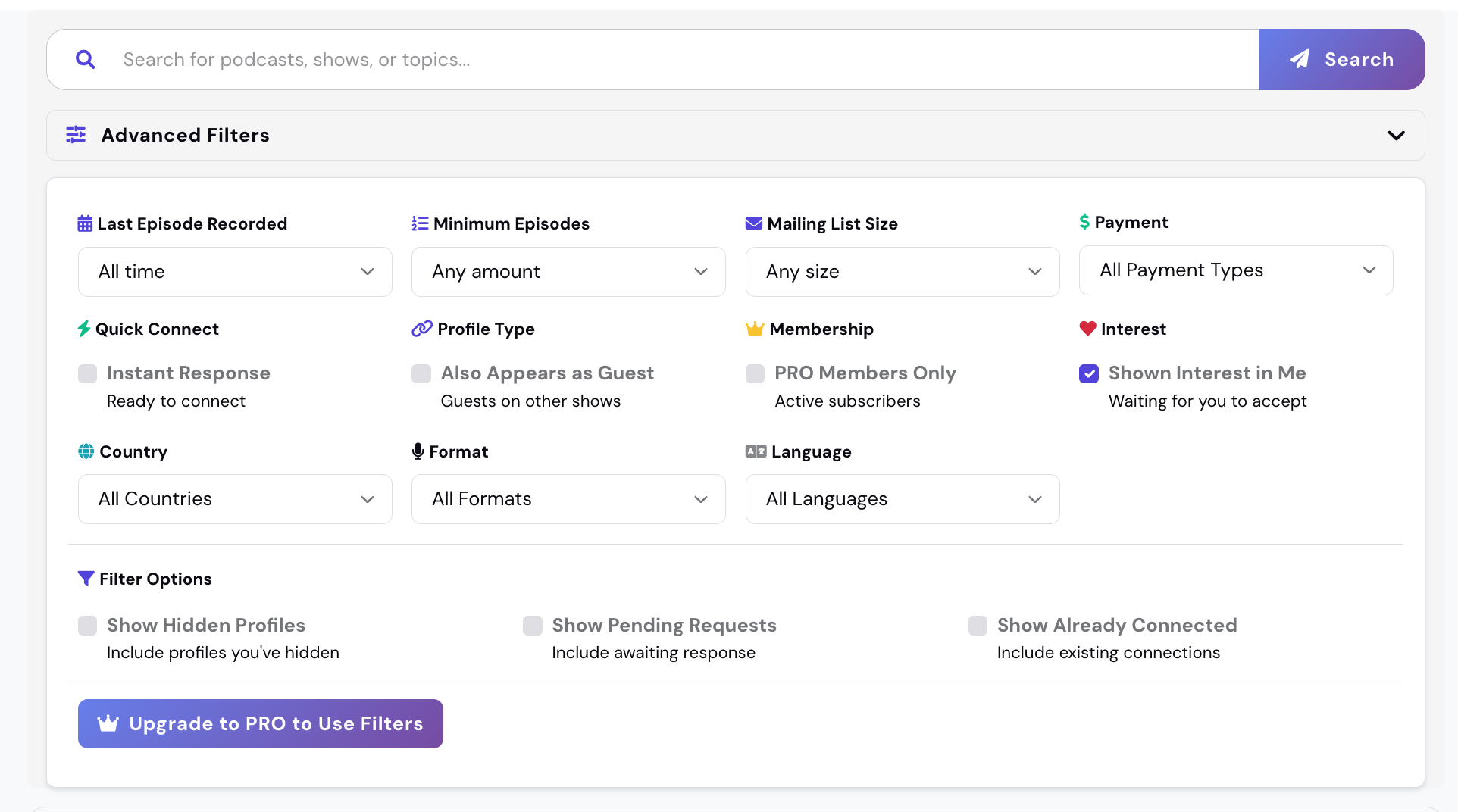
Once you’re inside the host discovery tool, most people go straight for the obvious filters and miss the ones that matter most. Here’s how to think about each one.
1. 📊 Audience Size

The most visible filter and the one most guests use incorrectly.
The mistake: Defaulting to the biggest audiences available and pitching up regardless of your current track record
The reality: If you’ve done three interviews total, pitching a show with 50,000 listeners per episode is a long shot, not because you’re not good enough, but because hosts with large audiences can afford to be selective about proven guests
The smarter move: Build your track record on well-matched mid-tier shows first, then use those appearances to unlock the larger rooms
2. 📅 Publishing Frequency
The filter that tells you how hungry a host actually is for new voices.
What the numbers mean: A show publishing twice a week needs guests constantly; a monthly show has roughly 12 guest slots per year
Why this changes your approach: High-frequency shows are easier to break into because the demand is real and ongoing; low-frequency shows require a stronger pitch because competition for each slot is higher
How to use it: Prioritize high-frequency shows when you’re building your track record, then layer in lower-frequency prestige shows as your credibility page fills out
3. 🎙️ Interview Style
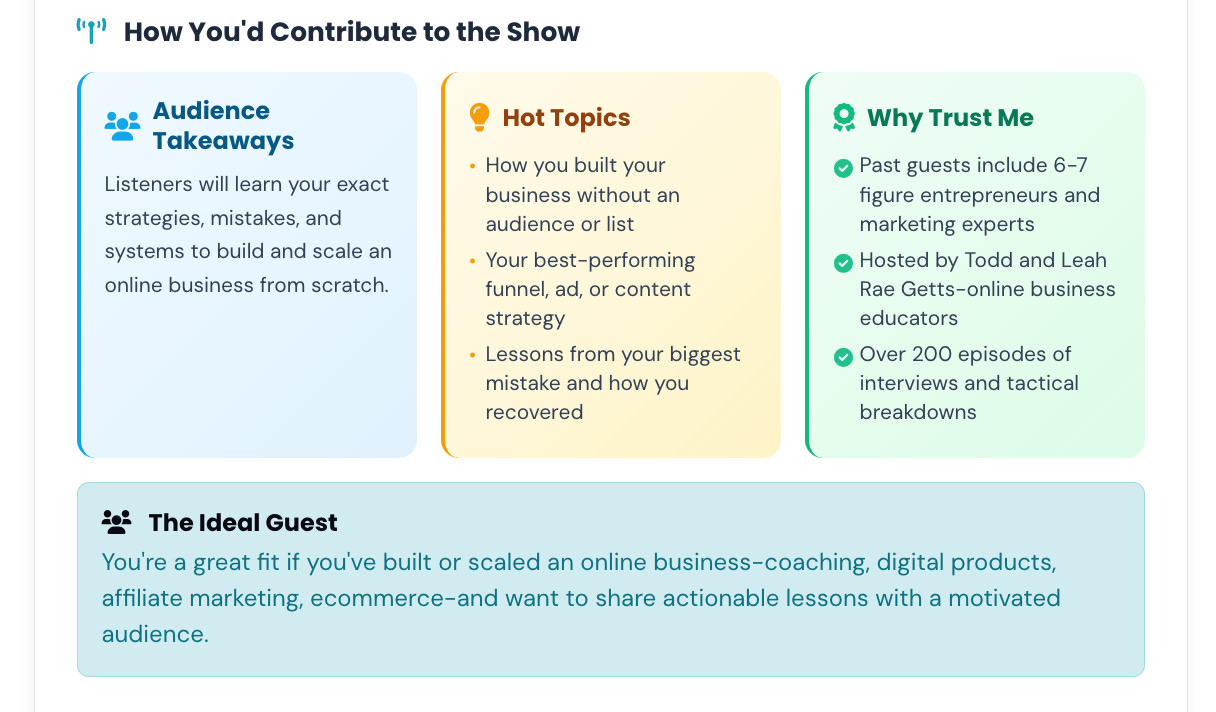
The most skipped filter and the one that most affects whether you’ll actually enjoy the conversation, not just whether you’ll get booked.
What the range looks like: Some hosts do deep research and arrive with their own questions; others want you to drive the whole conversation; some prefer loose dialogue while others run tight structured formats
Why it matters beyond preference: Pitching your style fit directly in your outreach is a credibility signal; it tells the host you actually listened to their show and thought about whether you belong on it
The practical upside: Interviews that match your natural style produce better episodes, which means better clips, better downstream traffic, and a stronger addition to your speaker page
💡 The filter most guests skip is interview style. It’s worth spending five minutes on a recent episode before you hit connect. That five minutes shows up in your pitch and hosts notice it.
The Honest Difference the Pro Plan Makes Here

I want to be straight with you on this because I don’t like soft-pedaling the practical reality.
Here’s what each Talks plan actually gives you:
Free plan: One connection request per month, basic filters, and access to build your speaker page.
Pro plan: Thirty connections per month, premium search filters, automations, and the ability to see actual audience size and email list data for every show you’re considering.
The math on 30 targeted connections per month versus 1 is not close. One is a test. Thirty is a strategy.
That said, the right sequence still matters:
Start with the free Talks Creator profile and get your speaker page built properly.
Make one targeted connection and see how the system responds.
Upgrade to Pro once your foundation is solid and you’re ready to scale the outreach.
Don’t pay for volume before you’ve fixed your foundation. The platform rewards quality profiles. A half-built page with 30 connections going out is worse than a polished page with 5.
The Shift That Changes Everything 🔄
Cold outreach is a numbers game you play against the odds.
Targeted matching is a positioning game you play with the odds in your favor.
When you pitch cold, you’re asking a host to take a chance on an unknown.
When you pitch through a matched system with a complete speaker page, a video pitch, and a clear audience fit, you’re giving a host a reason that already existed before you showed up.
That’s not a small difference. That’s the difference between a 2% acceptance rate and a meaningful one.
The goal isn’t to send more pitches. The goal is to send pitches that were already halfway to a yes before the host opened them.
Next week I’m going to show you what actually happens downstream when the bookings start coming in, and why the ROI on podcast guesting is so different from almost every other visibility channel you’ve tried.
This is Part 3 of a 5-part series on getting booked on podcasts faster and more consistently.
Here’s where we’re going:
✅ Part 1: Why most pitches fail
✅ Part 2: The speaker page that does your credibility work for you
✅ Part 3 (you’re here): How to find hosts who are already looking for someone like you
Part 4: What actually happens downstream when the bookings start coming in
Part 5: Why monthly thinking kills the strategy before it has a chance to work
🔖 Save this post before you start using the discovery tool. Come back to the three filters above and run through them on every show before you hit connect.
P.S. The filter most people skip is interview style. It’s the one that most affects whether you’ll actually enjoy the conversation, not just whether you’ll get booked.
Worth five minutes on a recent episode before you reach out. 👇
Keep Talking,
Liam
~
Visibility systems to grow your personal brand, audience + authority with guest appearances. First online sale in 2001. Built multiple 6–7 figure online businesses. 400+ interviews. Malta, Stockholm, Sydney. Love soccer, surf & burritos.