
The One Page That Does Your Pitching Before You Even Hit Send
How a properly built speaker page closes the credibility gap before a host ever reads your pitch

Yesterday I talked about the four reasons most podcast pitches get ignored.
Reason two was the one that stung the most once I knew exactly what was going on.
My pitch had zero credibility signal. I was describing myself instead of showing proof. And the fix I found wasn’t a better pitch but something that lives before the pitch.
It’s called a Talks Creator profile. And once I had one that was actually built well, it changed how hosts responded to me.
When a host gets your pitch, the first thing they do is look you up. They’re not reading carefully. They’re trying to answer one question fast:
Is this person real, and are they worth my time?
If what they find is a LinkedIn profile, a general website, and a social media account that hasn’t been updated in three months, the answer is usually no because nothing they found told them you were ready.
A Talks Creator profile answers that question before they even have to ask it.
Start Here Before You Build Anything 🛠️
Before we get into what goes on the page, the most important thing to understand is this: a Talks Creator profile is not a bio, resume or an “About Me” section dressed up nicely.
It’s a decision-making tool for hosts.
Every element on it should answer one of three questions a host is asking:
Is this person credible? Do they have proof behind their claims?
Is this person a fit? Will their topics land with my specific audience?
Is this person easy to work with? Have they made my job as a host easier or harder?
Build your page with those three questions as your filter and you’ll be ahead of 90% of the guests pitching right now.
What a High-Converting Speaker Page Actually Contains 📋
Here’s every element that matters, in the order hosts actually pay attention to them.
1. 🏷️ Your headline

The single line at the top of your page that tells a host exactly who you are and what you talk about.
What it’s not: Your job title, your credentials, or a vague descriptor like “entrepreneur and coach.”
What it actually is: The first five seconds of your pitch, written out in one sentence.
The test to apply: Could this headline have been written by someone in a completely different niche? If yes, it’s not specific enough.
2. 📖 Your story

A short version of how you got to where you are, written for context rather than for impressiveness.
What hosts are really looking for: Why your perspective is earned, not just claimed.
The length that works: 3 to 5 sentences is enough; anything longer starts to feel like a resume.
The tone to aim for: Conversational and specific, not polished and generic.
3. 🎯 Your topics
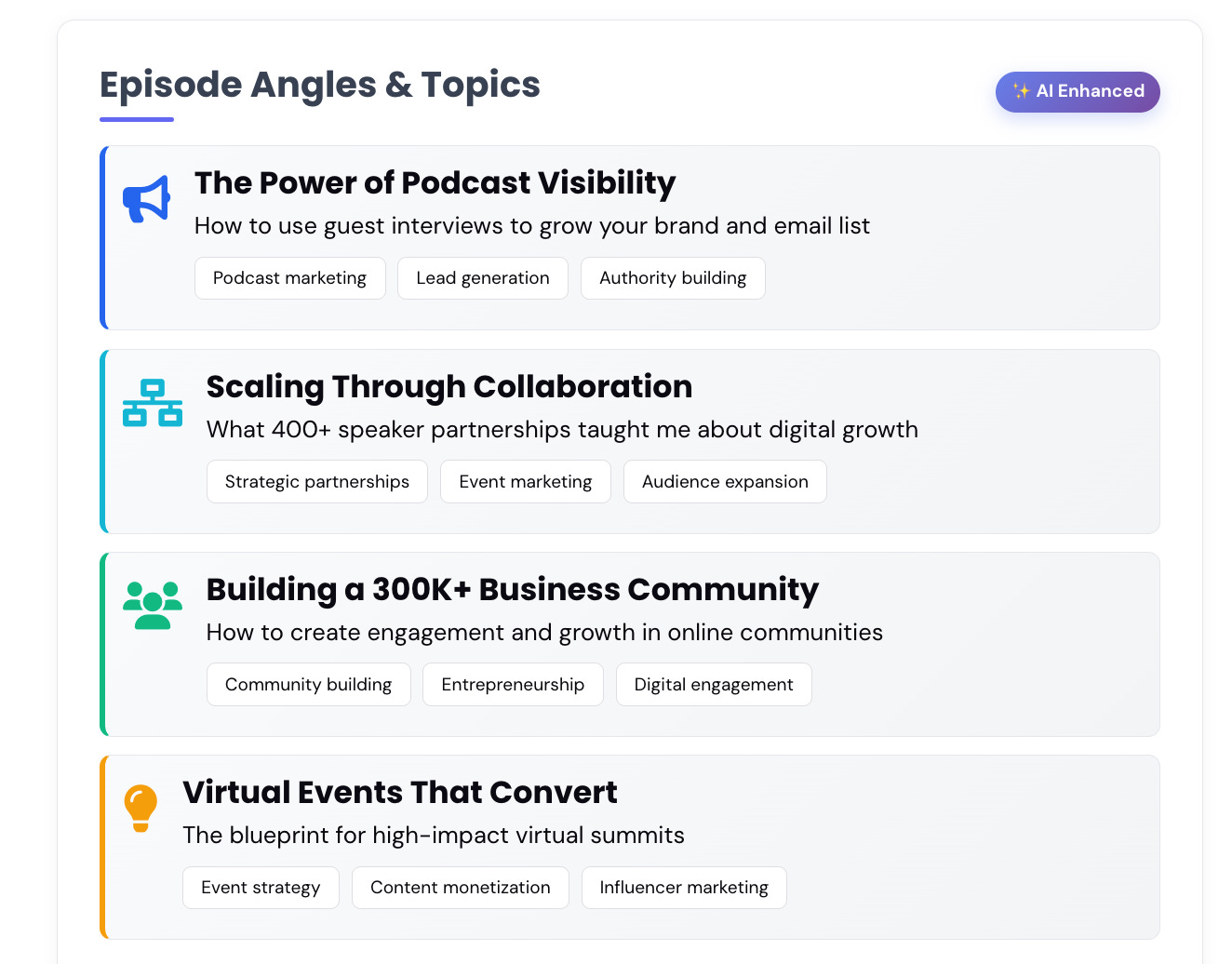
A focused list of things you can speak to, phrased the way a host would describe an episode to their audience.
The framing shift that matters: “How to grow a podcast audience without paid ads” books interviews; “podcast growth” does not.
How many to include: Five to eight podcast topics is the sweet spot; too few looks narrow, too many looks unfocused.
What to avoid: Topics so broad that any guest in your space could claim them equally.
4. ❓ Suggested interview questions

Five to seven questions a host could ask you, ready to use or adapt.
Why this is the most underused element: Most guests don’t do this, which means the ones who do stand out immediately.
What it signals to a host: That you understand how interviews work, that you’ve thought about their audience, and that you’re not going to make their pre-production harder.
The practical upside: Some hosts will use your questions almost word for word, which means you already know what’s coming.
Stuck on what specific questions you can share with hosts? The Talks Podcast Question Generator is free to use and gives you results in 60 seconds or less.
5. 🎙️ Your past appearances

A list of shows you’ve appeared on, even if they’re small.
Why small shows still count: A track record tells a host that someone else already took the risk and it went fine.
What no appearances means: Lead with your story and your topics harder; everyone starts somewhere and hosts know that.
How to present them: Show name, episode title if possible, and a link if the episode is still live.
6. 📹 A short video pitch
30 to 60 seconds of you, on camera, speaking clearly about what you bring to an interview.
Why this is the highest-leverage element on the page: Hosts can evaluate your presence, energy, and communication style in under a minute.
What it removes from their decision: The uncertainty about whether you’ll actually be engaging on mic, which is the risk every host is quietly carrying.
What “short” actually means: One minute maximum; if you can’t make your case in sixty seconds, that itself is information.
7. 🔗 Your lead magnet or offer link

A direct link to your freebie, landing page, or calendar, visible on your public profile.
Who this is actually for: Not the host; the audience members who find your page after hearing you on a show.
Why most guests miss this: They think of their speaker page as a tool for getting booked, not as a landing page that keeps working after the interview goes live.
The downstream value: This is the connection between your podcast appearances and your actual list growth.
💡 The element most guests skip is the video pitch. If you do nothing else after reading this, record sixty seconds on your phone and add it to your page. It doesn’t need to be perfect. It needs to exist.
Why I Built Mine on Talks Specifically 🔍
I could have built a speaker page on my own website. Plenty of people do. But there are two reasons I use Talks instead.
The first is that it lives inside a network.
Hosts on the platform can find your page through search and matching, not just through your pitch. You get discovered passively while you’re doing other things.
The second is that it connects directly to a host inbox.
When a host finds your profile and wants to reach out, they can do it inside the platform so you never lose track of emails and no threads go cold in a “general” inbox because every conversation lives in one place.
The free profile covers everything you need to get started (no credit card required).
Just build it, fill it out properly, and you’ll have something you can link to in every pitch you send from this point forward.
Make Sure You Answer This First 🤔
Before you write a single word on your speaker page, answer this:
What is the one transformation my ideal podcast audience walks away with after hearing me speak?
Not your credentials. Not your backstory. The outcome for the listener.
Every element of your speaker page should point back to that answer. Your headline frames it. Your topics deliver it. Your story earns the right to promise it.
Get that answer clear first and the rest of the page almost writes itself.
This is Part 2 of a 5-part series on getting booked on podcasts faster and more consistently.
Here’s where we’re going:
✅ Part 1: Why most pitches fail
✅ Part 2 (you’re here): The speaker page that does your credibility work for you
Part 3: How to find hosts who are already looking for someone like you
Part 4: What actually happens downstream when the bookings start coming in
Part 5: Why monthly thinking kills the strategy before it has a chance to work
🔖 Save this post before you start building. Use the seven elements above as your checklist and come back to it when you’re filling out each section.
P.S. The most common mistake I see on speaker pages is a generic headline. If yours currently says something like “speaker, author, and coach,” that’s the first thing to fix.
Reply and tell me what yours says right now. I’ll give you a quick reaction. 👇
Keep Talking,
Liam
~
Visibility systems to grow your personal brand, audience + authority with guest appearances. First online sale in 2001. Built multiple 6–7 figure online businesses. 400+ interviews. Malta, Stockholm, Sydney. Love soccer, surf & burritos.