
From Accepted Connection to Confirmed Recording Date
How to move a matched conversation forward, handle the scheduling process, and get your first interview on the calendar without losing momentum

Getting a connection accepted feels like the finish line when you’re new to this.
It isn’t. It’s the starting line for the part of the process that most beginners handle badly.
The gap between an accepted connection and a confirmed recording date is where more podcast opportunities disappear than at any other stage.
Hosts didn’t change their mind and it wasn’t because the fit was wrong. What really happened was that the conversation lost momentum and neither side had a system to keep it moving.
A confirmed recording date requires 3 things:
A conversation that moves forward with purpose.
A scheduling process that removes friction.
A way to track everything so nothing falls through the cracks.
The Talks inbox gives you all three.
Using it properly is what separates guests who fill their calendar from guests who collect accepted connections that never become episodes.
What to Say After a Connection Is Accepted 💬
The first message after a match opens sets the tone for the entire conversation. Most beginners either over-explain or under-communicate at this stage.
Two things belong in the first message after a connection is accepted.
Acknowledge the match warmly and briefly: One sentence that signals you’re genuinely interested in the conversation and not just moving through a checklist of connections.
Move immediately toward the next step: Ask a specific question or make a specific suggestion that gives the host something concrete to respond to.
What that looks like in practice:
“Really glad we matched. I’d love to explore what an episode could look like for your audience. Would it help if I sent over a few topic angles we could build from?”
Short. Warm. Moves forward.
That’s the whole goal of the first post-match message.
How to move from conversation to scheduled interview 📅
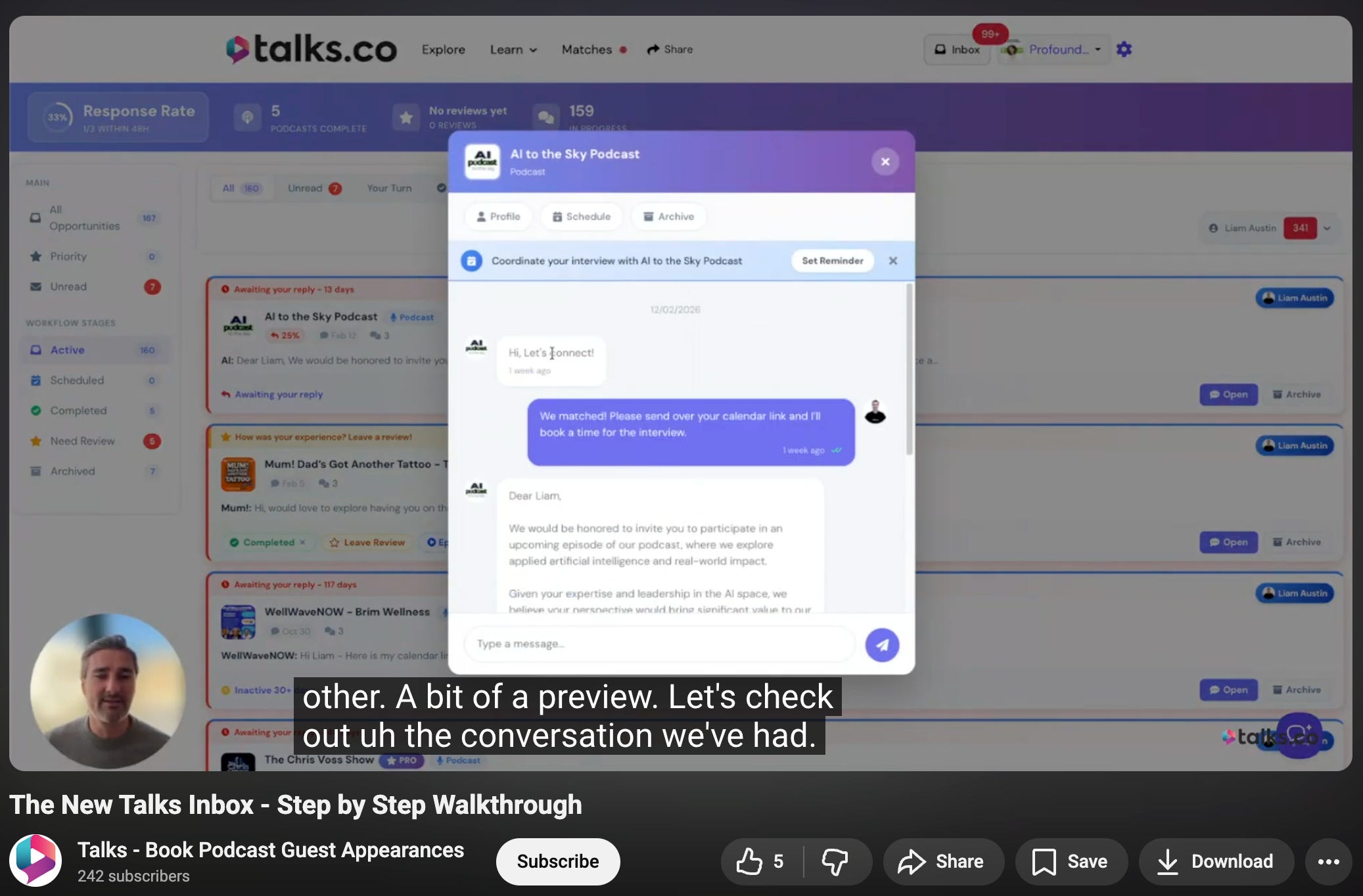
Most conversations stall because neither side takes clear ownership of the scheduling step. Avoid that by making the ask explicit and making it easy.
Three approaches work consistently at this stage.
1. 🗓️ Offer your availability directly
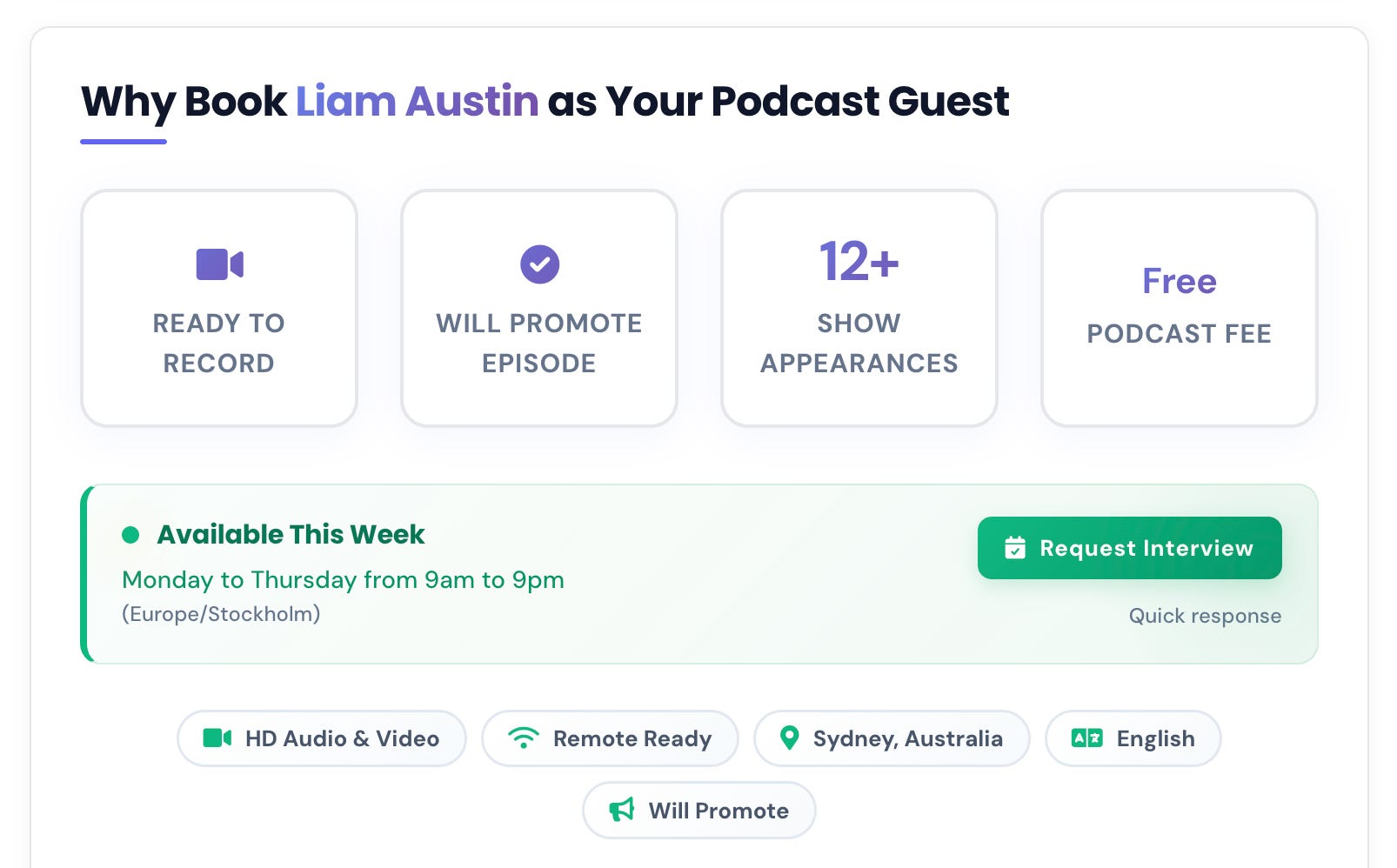
Rather than asking the host when they’re free and waiting for them to respond with options, offer two or three specific windows and let them choose.
What this looks like: “I’m available [day] at [time] or [day] at [time] across [timezone]. Happy to work around your schedule if neither works.”
Why this approach works: It removes the back-and-forth that kills momentum and signals that you’re organized and easy to work with.
What to include: Your timezone and a note that you’re flexible. Hosts are managing multiple guests and anything that reduces scheduling friction works in your favor.
2. 📋 Send your topic angles before the call
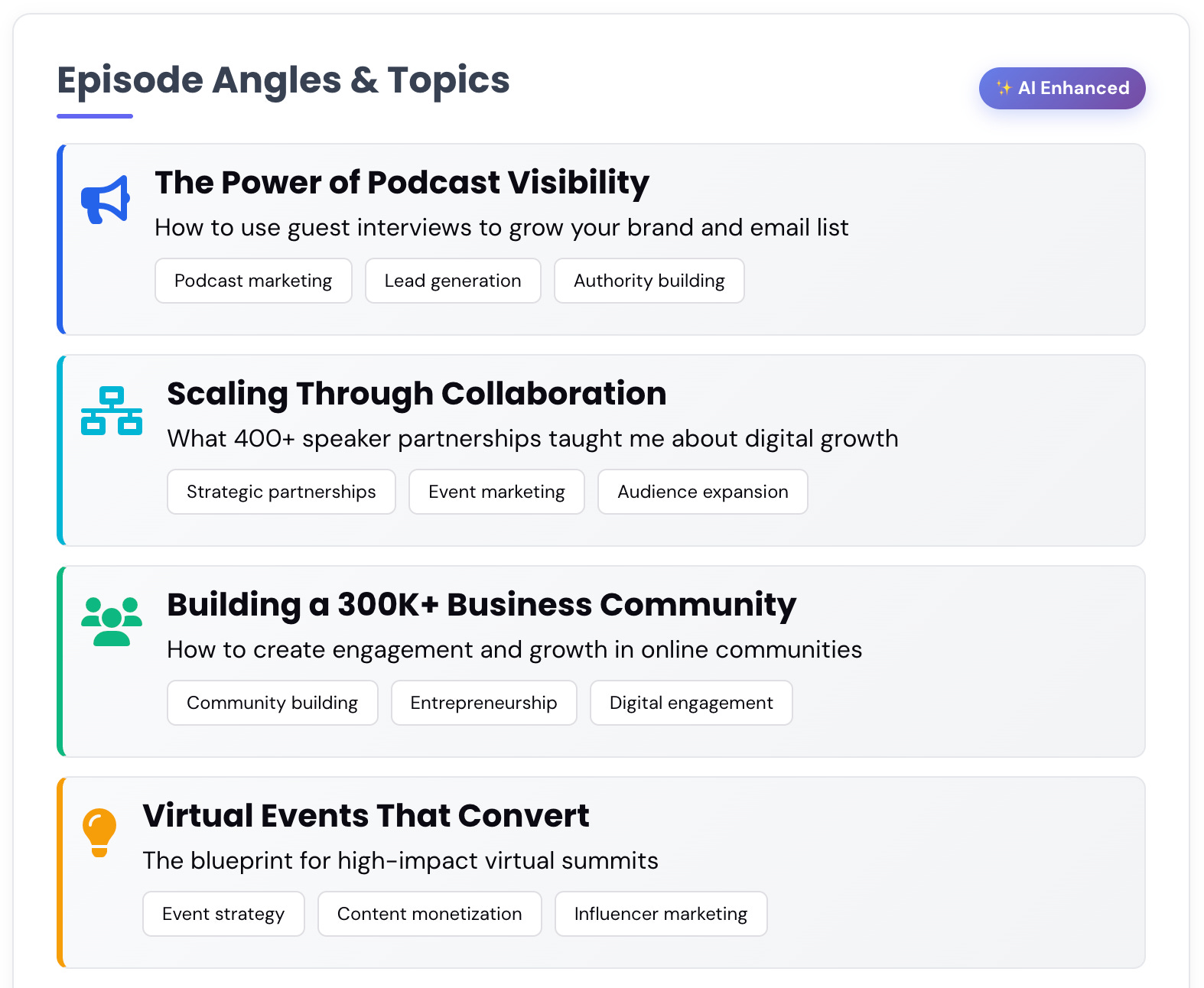
Offering 2 or 3 specific episode angles before the host has to ask for them moves the conversation from vague interest to concrete planning.
What topic angles look like: “I could cover [specific angle 1] which would work well for [their audience type], or [specific angle 2] which tends to generate strong listener response in [niche], or [specific angle 3] if you want to go deeper on [topic].”
Why this matters: A host who can see a specific episode forming is a host who’s ready to schedule; vague interest becomes concrete interest the moment the episode idea is clear.
Where these come from: Your suggested interview questions section on your profile; if you built it properly in Post 1 this step is already half done.
3. 🔗 Use the Talks inbox to log the scheduled date
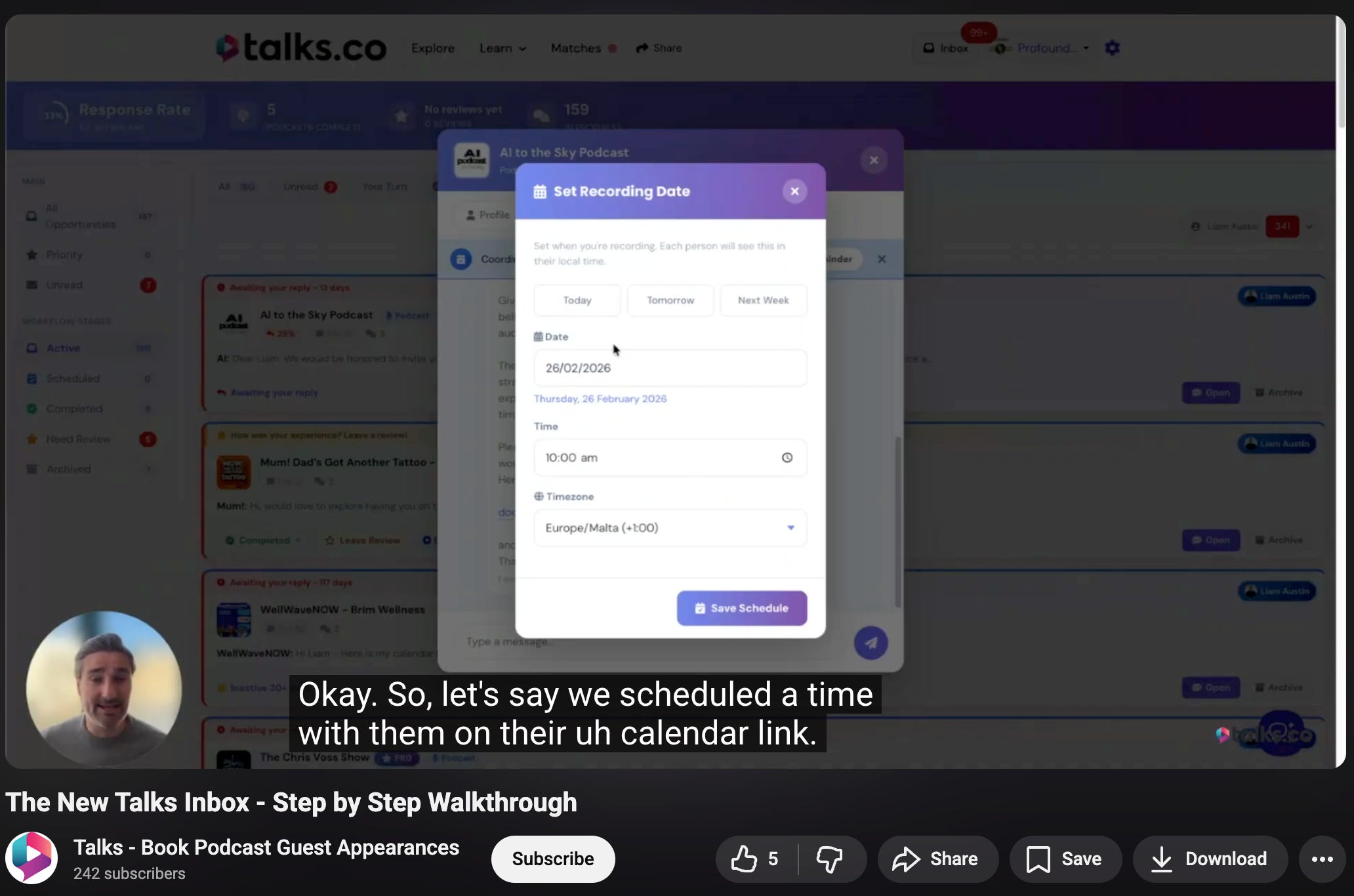
Once a time is agreed on log it inside the Talks system rather than just on your own calendar.
What logging inside Talks does: Activates the platform’s reminder system so both you and the host receive reminders as the recording date approaches and reduces no-shows and last-minute cancellations significantly.
What it adds to your Talks profile: Your scheduled count becomes visible to other hosts who look at your profile. A growing scheduled count signals that you convert conversations into actual recordings consistently.
How to do it: Go to the conversation in your inbox, move it to the scheduled stage, and enter the date and time. It takes 30 seconds and makes a meaningful difference to your profile’s credibility signals.
What To Do While You Wait for the Recording Date
A confirmed recording date doesn’t mean the work stops. Two things keep the momentum alive between the scheduling message and the actual interview.
1. Send a confirmation message the day before
A brief message the day before the recording signals professionalism and reduces the chance of a last-minute no-show on either side.
What to include: a confirmation that you’re looking forward to the conversation, the agreed time and timezone, and the platform or link you’ll be using to record
What not to include: a full briefing document, extensive background on yourself, or anything that creates more work for the host before the call
Length: two to three sentences; this is a confirmation, not a pre-interview
2. Prepare your 3 talking points

Three clear talking points prepared in advance is the difference between an interview that meanders and one that delivers consistent value regardless of what direction the host takes the conversation.
What a talking point is: A specific insight, story, or framework you can bring into the conversation naturally when the opportunity arises.
Why three specifically: Enough to give the conversation depth and direction without over-preparing to the point where you sound scripted.
Where they come from: Your suggested interview questions; if you built them properly they already map to the talking points worth preparing.
💡 The inbox workflow in Talks moves conversations through five clear stages: active, scheduled, completed, need review, and archived.
Moving every conversation deliberately through each stage keeps your pipeline organized, builds your authority signals, and ensures nothing valuable disappears into an ignored folder.
Use the stages. They exist for exactly this.
When conversations go quiet before scheduling 📭
Some conversations will accept your connection and then go quiet before a recording date is confirmed. That’s normal and it doesn’t require alarm.
Wait 3 to 5 days after your initial post-match message before following up: Anything sooner reads as impatient. The host is likely managing multiple conversations and priorities simultaneously.
Send one short follow-up that re-opens without pressure: “Just circling back in case this got buried. Still happy to explore an episode if the timing works for you.”
Archive after two unanswered messages: Two touch points with no response is a clear enough signal. Move the conversation to archived and focus on the connections that are already moving forward.
Rate the match honestly: Marking a profile where the conversation stalled helps the algorithm calibrate future matches toward hosts who are more actively booking right now.
Every archived conversation is information. The ones that stall before scheduling teach you as much as the ones that convert.
This is Part 3 of a 5-part series on landing your first 10 podcast bookings on Talks.co.
The full series:
✅ Part 1: Creating a guest profile hosts actually want to book.
✅ Part 2: Sending your first connection request and starting conversations with hosts.
✅ Part 3 (you’re here): Moving from accepted connection to confirmed recording date.
Part 4: Preparing for your first interview and delivering a great guest experience.
Part 5: Turning one podcast appearance into reviews, leads, referrals, and future bookings.
🔖 Save this post before your first connection gets accepted. The 3 approaches to moving from conversation to scheduled interview above are the ones that work consistently for beginners who are building momentum rather than waiting for it.
P.S. Logging your confirmed recording date inside the Talks inbox rather than just on your own calendar is a thirty-second action that activates the platform’s reminder system, adds to your scheduled count on your public profile, and reduces the chance of a no-show on either side. Small action. Meaningful impact. 👇
Keep Talking,
Liam
~
Visibility systems to grow your personal brand, audience + authority with guest appearances. First online sale in 2001. Built multiple 6–7 figure online businesses. 400+ interviews. Malta, Stockholm, Sydney. Love soccer, surf & burritos.