
400+ Interviews. No Podcast of My Own. Now I'm Choosing RedCircle (Or Not).
The RedCircle fee structure I almost missed. And I should have known to look.

I don’t know if I should be telling you this but even though:
I co-founded Talks, a platform that connects coaches with podcast hosts.
I’ve interviewed over 400 entrepreneurs, founders, and experts.
I’ve coached people on how to use podcast appearances to build visibility, generate clients, and grow their authority.
I’ve watched people launch shows, build audiences, and turn a single interview into a six-month client pipeline.
I have never published a single episode of my own podcast.
So, What’s the Plan?
I’m planning to start one in 2026. And the first thing that happened when I sat down to actually plan the steps it was not what I expected. I didn’t feel like an expert.
I felt like every other person who’s opened a browser tab at 11 pm and typed “best podcast hosting platform” and waited to feel less confused.
RedCircle was on my list.
So was Buzzsprout.
So was Transistor.
So were four others.
I had to work through it like everyone else does.
Turns out knowing how the game works doesn’t exempt you from playing it.
What RedCircle Forces You to Admit When the Show Is Finally Yours
The uncomfortable part to admit.
Being a guest on 400+ shows, hosting 35 virtual summit speakers, building a platform for podcast connection: none of that prepared me for the specific decision of which hosting platform to use for my own show.
Those experiences taught me:
How to perform on the mic.
How to prepare talking points.
How to make a host look good.
How to make myself worth remembering.
How to turn a 45-minute conversation into a three-month relationship.
They didn’t teach me the difference between RedCircle’s monetization fee structure and Buzzsprout’s pricing tiers at scale. Because I never needed to know that.
I was always someone else’s guest, living inside someone else’s infrastructure.
Now I’m the one who has to build the infrastructure. And the question I kept getting wrong in my head was the same question I watch creators get wrong all the time.
The Assumption I Almost Made (Even After All This Time)
My first instinct when evaluating platforms was distribution.
Which platforms does it push to?
Is the RSS feed reliable?
Does it reach Spotify and Apple automatically?
I caught myself. Because that’s the wrong first question, and I know it’s the wrong first question, and I almost asked it anyway.
Distribution is table stakes. Every serious hosting platform does this now.
Evaluating on distribution alone in 2026 is like choosing a recording setup based on whether the microphone has a cable.
Yes it has a cable. They all have cables.
The question that actually separates platforms is what happens when you try to make money from the show.
RedCircle has:
Monetization tools
Advertising opportunities built into the platform
Listener support features
Subscription options.
These are real tools with real utility if revenue is part of the plan. But they come with fee structures that vary, and those fee structures are not the first thing you see on the landing page.
They’re the thing you find when you go looking. Or, if you’re not careful, the thing you find after you’ve already committed.
I’ve talked to creators who built on a platform because it felt like the right fit, got real traction, moved toward monetization, and discovered the revenue share terms for the first time.
By then, switching platforms is a disruption. Staying means accepting an agreement you didn’t consciously make.
That’s not bad luck. That’s an evaluation that led with the wrong question.
What RedCircle Is Actually Asking You to Decide
When you sit down with a RedCircle comparison, you’re not comparing features. You’re comparing business models dressed up as features.
Podcast hosting platforms make money somewhere. Some charge monthly fees. Some take a percentage of ad revenue. Some charge transaction fees on listener support. Some are free at entry and monetized at scale.
The podcast hosting platform that looks free right now may be the most expensive one you’ve ever used by the time your show matters.
The checklist I ran when I stopped defaulting to distribution metrics:
What is the fee structure for monetization features, not just hosting?
What does it cost me per transaction if I run listener support or subscriptions?
What tier will I realistically be on in eighteen months, and what does that cost?
If I leave, what happens to my RSS feed and my subscriber history?
Does the platform’s revenue model align with how I plan to make money from this show?
These questions are not exciting. They feel like the boring part.
They’re also the part that determines whether the platform is working for you or extracting from you when the show is finally worth something.
Why I’m Telling You This Instead of Just Publishing a Comparison Table
Because I almost got it wrong.
Not because I didn’t know better in the abstract. Because the platform decision, when it’s your platform and your show and your money on the line, has a way of pulling you back to the surface question.
Which one looks good. Which one other people use. Which one came up first in the search results.
I started my first virtual summit in 2015 with a Logitech C920 webcam and a Blue Yeti mic I still own. I used Zoom for the interviews. Nothing fancy. By the time that summit closed, I had 15,000 new leads and Vimeo had signed on as a sponsor for twelve months.
The infrastructure was whatever I could get working fast. The question I was really asking wasn’t which tool is best.
It was: what am I building, and does this tool serve that thing specifically?
Same question applies to a hosting platform.
What are you building?
A show that runs ads?
A subscription community?
A client acquisition tool that never monetizes directly?
A brand play with a long runway before revenue?
RedCircle may be exactly right for one of those and actively wrong for another.
You don’t find that out on the features page. You find it in the pricing documentation for monetization, which is a different page entirely.
The RedCircle Decision I’m Actually Making
Still deciding. That’s the honest answer.
What I know is that I’m not going to make the call based on which platform has the best distribution, because they all have adequate distribution. I’m going to make it based on the revenue model I’m building toward and the fee structure I’m willing to operate inside for the next two years.
That’s a slower decision than picking the platform everyone in the Facebook group recommends. It’s also the decision I should have been telling people to make for years. Turns out I needed to be in the position of actually making it to say it clearly.
RedCircle may be the answer. So might something else. But I’ll know it’s right for specific, defensible reasons. Not because it came up first.
You’re not picking a platform. You’re picking the terms of the business you’re agreeing to operate inside.
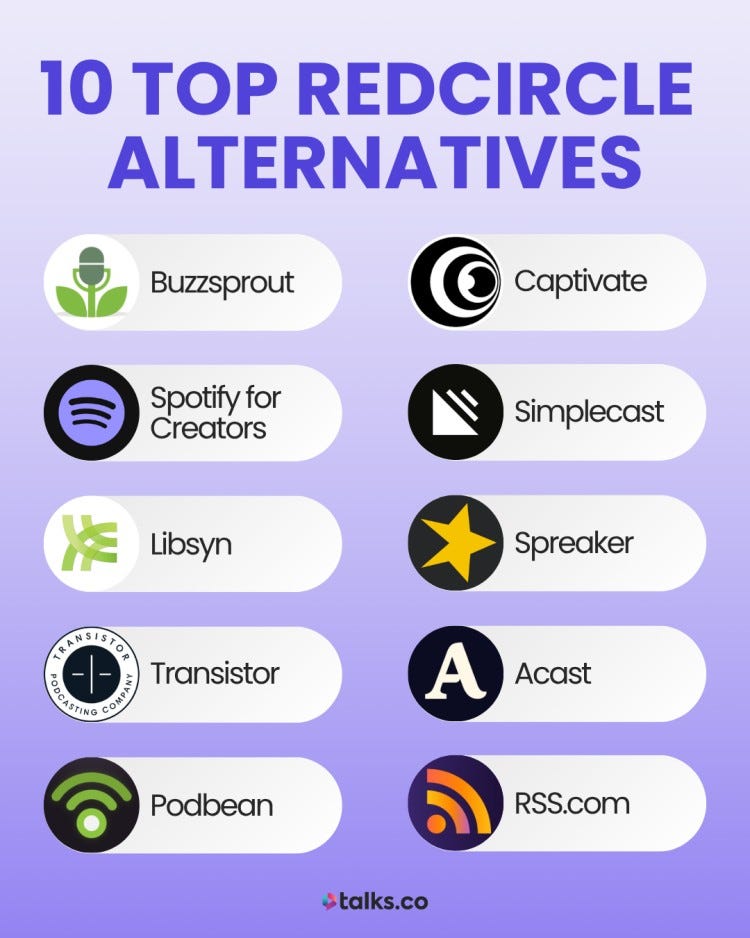
If you’re in the middle of this decision right now, the full RedCircle breakdown, including how it works, what it costs, and how it compares to the top ten alternatives, is at the link below. Read the fees section first.
Choosing a podcast hosting platform based on distribution reach alone is making a business decision by looking at the wrong column.
Stay ready by reading the full RedCircle breakdown, including setup steps, fee structure, and top 10 alternatives.
I’m still deciding on RedCircle myself. What do you wish someone had told you when you were choosing? I’m all ears.
Keep Talking,
Liam
~
Visibility systems to grow your personal brand, audience + authority with guest appearances. First online sale in 2001. Built multiple 6–7 figure online businesses. 400+ interviews. Malta, Stockholm, Sydney. Love soccer, surf & burritos.