
Your Talks Speaker Page Is a Landing Page. Most People Build It Like a Bio.
How to optimize your Talks.co speaker page for conversion so that every host who finds you and every listener who looks you up has a clear reason to take the next step

Getting booked on a podcast is not the same as generating a lead from a podcast.
Most guests never close that gap. Instead, they build a speaker page that describes who they are, get booked on shows, deliver good conversations, and then wonder why the appearances aren’t producing clients.
The visibility is real. The business outcome just isn’t materializing and the problem almost always lives in the speaker page.
A speaker page optimized for visibility tells people who you are.
A speaker page optimized for conversion tells people what to do next.
Those two things look similar on the surface and produce completely different results in practice.
Difference Between a Visibility Page and a Conversion Page
Most Talks speaker pages are built to impress. A conversion page is built to move.
Every element on a conversion page answers one question: what should the person reading this do next?
For a host evaluating whether to book you, the next step is sending a connection request.
For a listener who just heard you on a podcast and looked you up, the next step is joining your list, booking a call, or downloading your lead magnet.
For someone who found your profile through Google or an AI search result, the next step is understanding immediately whether you’re the right person for what they need.
A page that doesn’t answer that question for each of those 3 visitors is leaving the conversion to chance. Most speaker pages do exactly that.
6 Elements That Turn a Speaker Page Into a Conversion Asset 🛠️
Six elements on your Talks speaker page determine whether a visitor takes action or leaves. Each one has a visibility version and a conversion version and the gap between them is where most guests lose leads they never knew they had.
1. 🏷️ Your headline
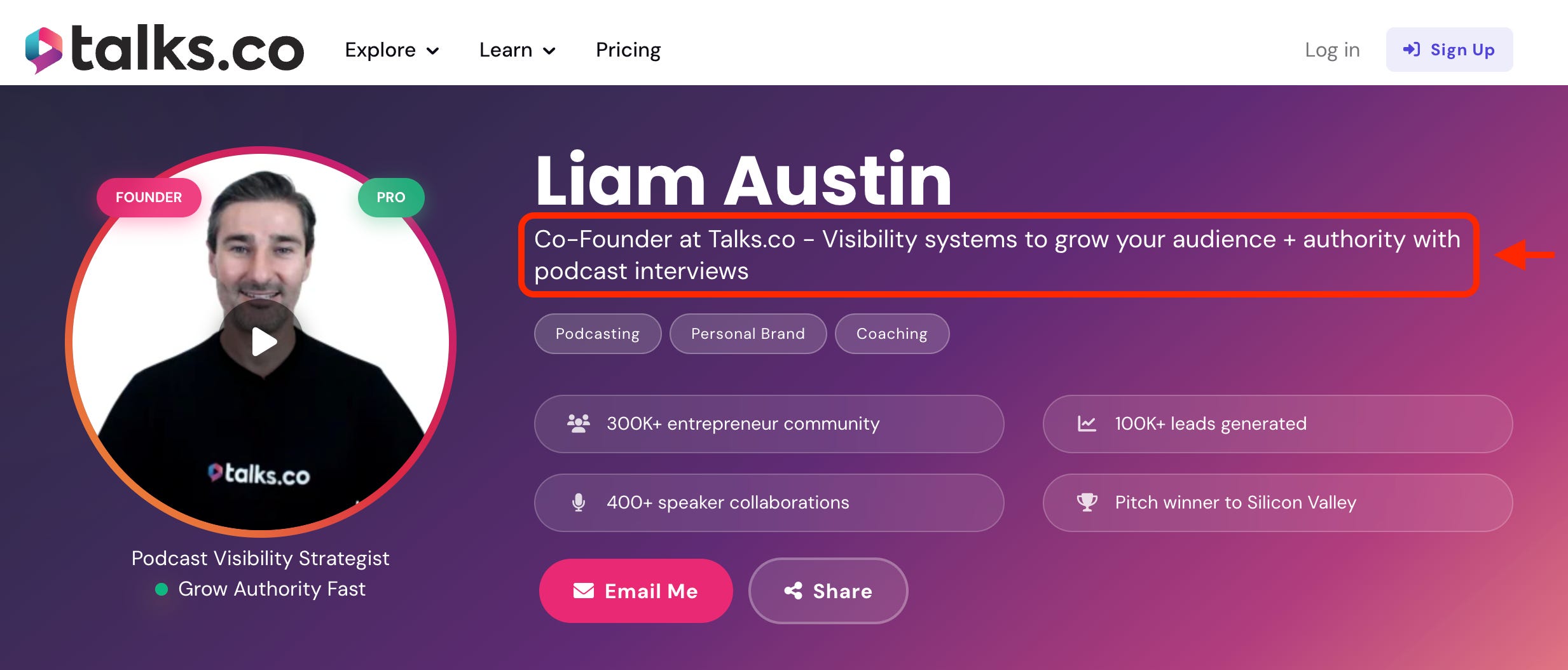
The visibility version describes your role. The conversion version names the outcome you create for a specific person.
Visibility headline: “Business coach and podcast host.”
Conversion headline: “I help early-stage coaches land their first ten clients without paid ads.”
The test: Read your headline and ask whether a complete stranger would immediately know if you’re relevant to them. If the answer requires any interpretation the headline needs to be more specific.
2. 📖 Your story

The visibility version summarizes your career. The conversion version earns the right to make a claim by showing where the expertise comes from.
What a conversion story includes: One specific moment or decision that changed your understanding of your topic, one concrete result that came from that shift, and one sentence that connects both to what you now help other people do.
What to cut: Credentials that don’t connect to outcomes, job titles that describe what you did rather than what you learned, and any sentence that could appear on any expert’s page in your space.
Length that works: 4 to 6 sentences are enough to establish context without asking the visitor to work for it.
3. 🎯 Your topics
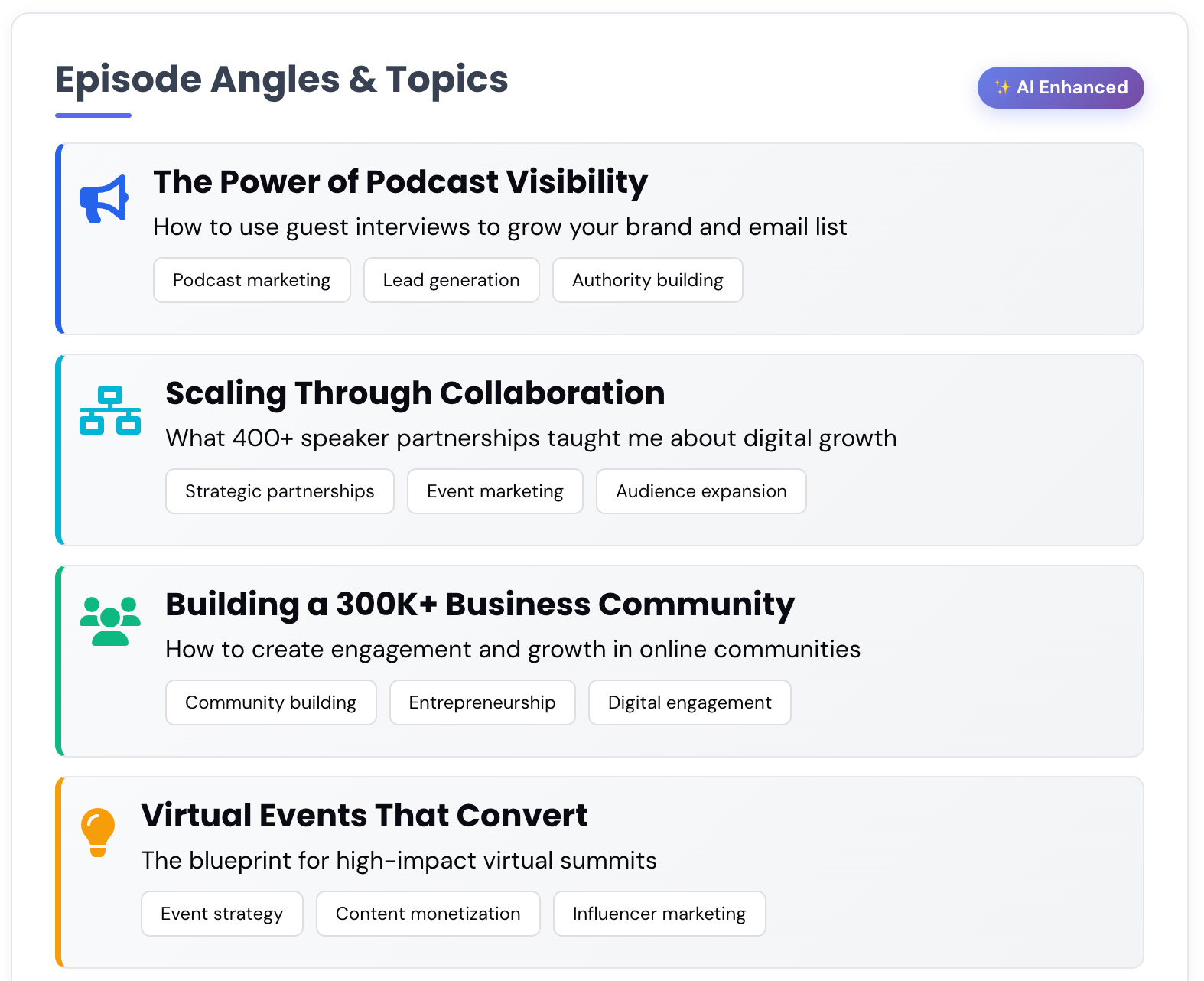
The visibility version lists subjects you cover. The conversion version names the specific problems you solve or the specific transformations you produce.
Visibility topics: “Leadership, mindset, entrepreneurship, personal development.”
Conversion topics: “How coaches price their services without underselling, building a client pipeline that doesn’t depend on referrals, the mindset shift that separates coaches earning $3k a month from coaches earning $30k.”
Why specificity converts: A podcast host reading specific topics can immediately picture an episode and a listener reading specific topics can immediately see whether the conversation was about their problem.
4. ❓ Your suggested interview questions
The visibility version demonstrates that you can speak on your topics. The conversion version demonstrates that you understand the host’s audience well enough to have already planned the conversation.
What conversion questions look like: Phrased from the listener’s perspective rather than your own like “What’s the most common mistake coaches make when they first start charging premium prices?” rather than “Tell us about your coaching methodology.”
Why listener-perspective questions convert: They signal to the host that you’ve thought about what their audience needs rather than what you want to say. Podcast hosts who see questions written for their audience book guests faster than hosts who see questions written for the guest’s expertise.
How many to include: 5 to 7 are enough to show range without overwhelming.
5. 🎙️ Your past appearances
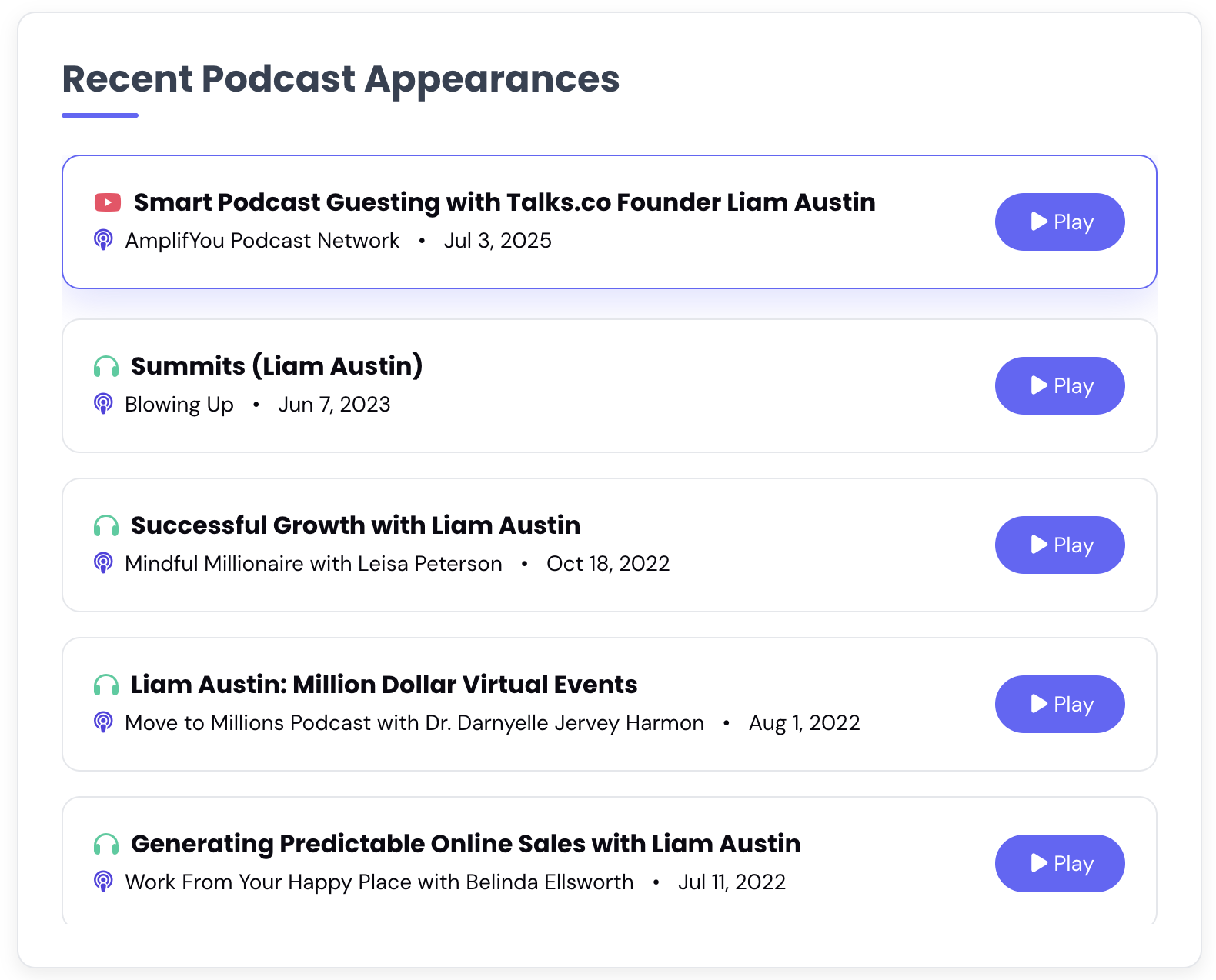
The visibility version lists shows you’ve appeared on. The conversion version uses past appearances as social proof that other trusted hosts have already made the bet on you and it paid off.
What to add beyond the show name: A one-line description of what the conversation covered and why it was relevant to that show’s audience.
What this does for hosts evaluating you: It removes the risk from their booking decision by showing that someone else already took that risk and the episode was worth making.
What this does for listeners who find your profile: It gives them a trail of conversations to follow if they want more before deciding whether to reach out.
6. 🔗 Your profile URL
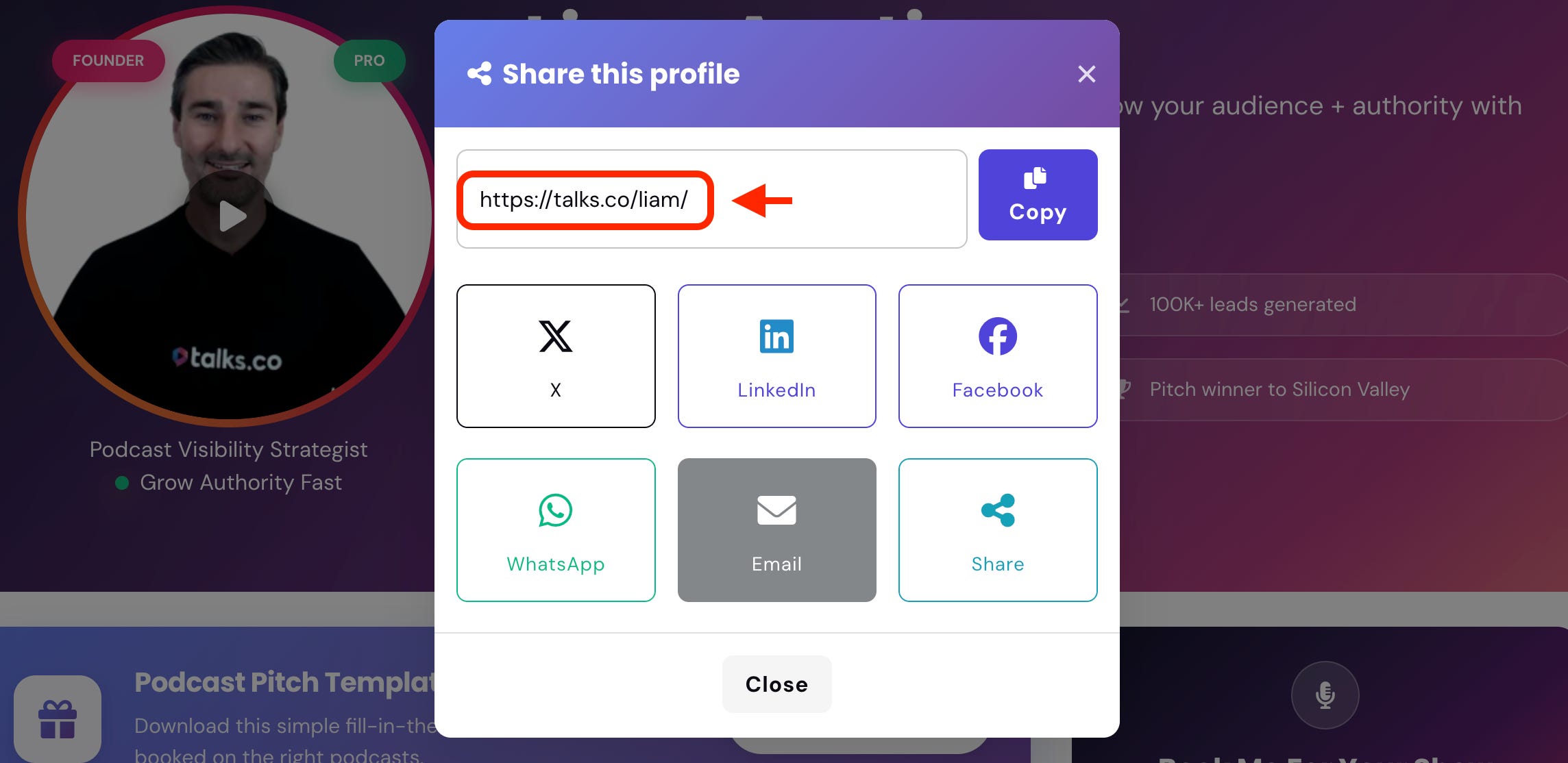
The visibility version exists. The conversion version is actively distributed.
Where your Talks profile URL belongs: Your email signature, every social bio, your website’s about or speaker page, the show notes of every episode you appear on, and any content you create where potential clients or hosts might find you.
What active distribution produces: A page that accumulates Google ranking, referral traffic, and AI search visibility over time rather than sitting idle waiting to be found.
The simplest version of this habit: Every time you appear on a podcast, add the episode to your profile and share the profile link rather than just the episode link. One action, two outcomes.
💡 The conversion gap on most speaker pages lives between the last section and the visitor’s next action. A page that ends with your past appearances and nothing else is a page that asks the visitor to decide what to do next on their own. Most of them decide to leave. The next post in this series covers the one feature that closes that gap more effectively than any other element on the page.
The Audit Worth Doing Before Anything Else 🔑
Pull up your Talks speaker page right now and ask six questions.
Does your headline name a specific outcome for a specific person?
Does your story show where the expertise comes from rather than just claiming it exists?
Do your topics name problems or transformations rather than subjects? Are your suggested questions written from the listener’s perspective?
Do your past appearances include context beyond the show name?
Is your profile URL actively distributed across every place your ideal client or host might find you?
Every no is a conversion that’s currently leaving your page without taking action.
Fix the ones you can fix today. The rest of this series covers the features that handle the ones a better page alone won’t solve.
This is Part 1 of a 5-part series on turning your Talks profile into a lead machine.
The full series:
✅ Part 1 (you’re here): Optimizing your Talks speaker page for conversion instead of visibility
Part 2: Creating a video pitch that builds trust before the host call
Part 3: Using lead magnets to capture list growth from every podcast appearance
Part 4: Connecting podcast interviews to real business outcomes and client conversations
Part 5: Building a podcast guesting system that generates leads long after the interview ends
🔖 Save this post before you open your Talks profile. The six-element audit above is the fastest way to identify exactly where your page is losing conversions right now.
P.S. The suggested interview questions section is the element most guests treat as optional and the one that most directly signals to a host whether you understand their audience. Questions written from the listener’s perspective book interviews faster than questions written from the guest’s expertise. Rewrite yours before your next connection request goes out. 👇
Keep Talking,
Liam
~
Visibility systems to grow your personal brand, audience + authority with guest appearances. First online sale in 2001. Built multiple 6–7 figure online businesses. 400+ interviews. Malta, Stockholm, Sydney. Love soccer, surf & burritos.