
Pretty Motivated Is Not a Motivation Assessment Scale
A motivation assessment scale produces what conversation never can

There’s a version of coaching that looks like this: you ask your client how motivated they feel, they say “pretty motivated,” and you nod and move forward.
Nothing wrong with that exchange. Except you’ve just built your next session on a phrase that means nothing.
“Pretty motivated” can mean they thought about their goal twice this week and felt good. It can also mean they’re on the edge of quitting and don’t want to say it.
You have no way to know which one, and neither do they, because they’ve never been asked to measure it.
What a Motivation Assessment Scale Actually Does
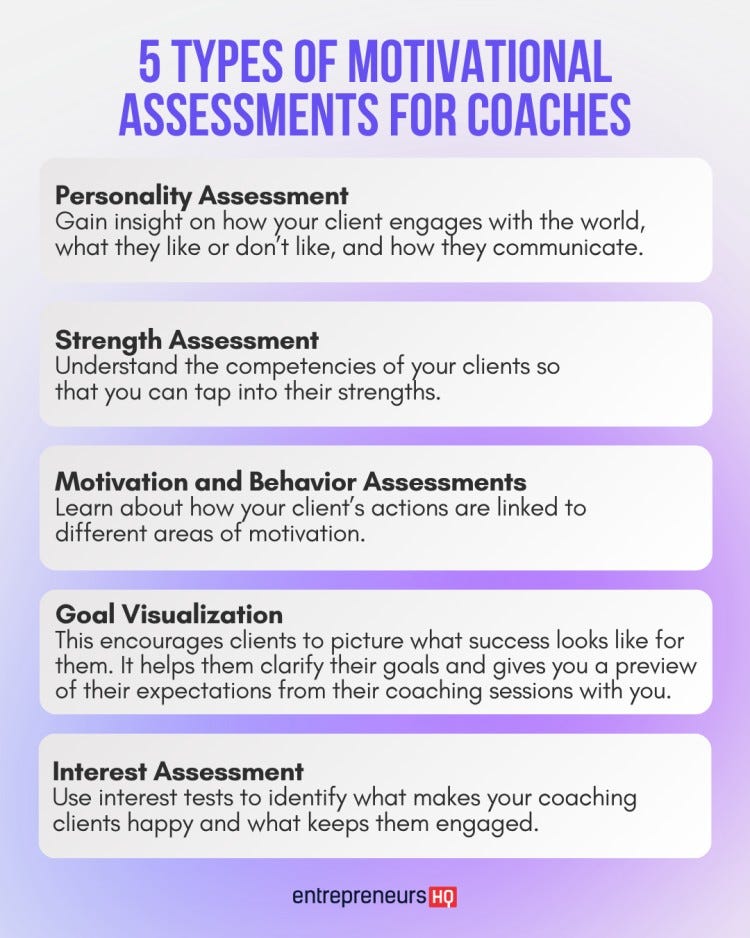
A motivation assessment scale is a structured evaluation tool. It runs as a questionnaire, uses numerical scoring, and has predefined ranges that tell you what a score means before the client ever fills it in.
The client answers a series of questions. Each answer maps to a number. The numbers combine into a score. The score sits inside a range that has an interpretation attached to it.
That’s it. That’s the whole mechanism.
What changes when you use one isn’t the client’s motivation. It’s the specificity of what you know.
Without the assessment, your client is “pretty motivated.”
With it, they’ve scored 34 out of 50, which puts them in the moderate range, meaning there’s engagement but also friction you haven’t surfaced yet.
One of those is a feeling. The other is a position. And a position is something you can work from.
This distinction matters more than coaches tend to admit. Feelings shift with the weather. A score from last Tuesday is still a score from last Tuesday when you sit down together the following week.
The Interpretation Gap
Most coaches are good at reading people. Years of conversations, pattern recognition, a feel for when someone’s in it versus when they’re performing enthusiasm.
But good instincts have a problem: they don’t transfer.
What you sense in a conversation doesn’t survive the week between sessions. It doesn’t show up in your notes in any useful form.
You can’t show a client how they’ve shifted over three months using your gut feeling. You can describe it. You can reference it. But you can’t point to it.
Structured scoring does something different. The number from session one sits next to the number from session eight.
You can see movement without having to reconstruct your memory of how they seemed.
You can ask what happened between those two numbers.
You can let the client compare them and watch what surfaces.
That comparison is where assessment scales earn their keep. Not in the initial score. In the delta.
Why Vague Stays Vague
Motivation gets discussed in coaching constantly. How many times it gets measured is a different question.
And the gap between discussing and measuring is where a lot of clients stay stuck.
They leave sessions feeling seen and heard and understood. They don’t leave with any clearer picture of where they actually are or how to know when they’ve moved.
That’s not a failure of care. It’s a failure of structure.
When you build measurement into the coaching program, you’re not adding bureaucracy.
You’re giving the client a mirror that doesn’t lie. They reported a 3 on persistence three weeks ago. Today they reported a 7. Something changed.
Now you can ask what changed, and the client has a frame to answer from rather than a vague sense that things feel better.
That specificity compounds.
A client who can track their own movement builds a different relationship to their progress than a client who has to rely on whether the last session felt good.
What This Changes for the Coach

There’s a visibility angle here that rarely gets talked about.
Coaching that produces evidence looks different from the outside than coaching that produces impressions. When a client can point to where they started and where they ended up, in numbers both parties agreed on before the work began, the story they tell about working with you changes. It becomes something a stranger can understand without having been in the room.
The number from session one sits next to the number from session eight. That comparison is where the real coaching conversation starts.
A motivation assessment scale won’t tell you everything about a client. It doesn’t replace the conversation. What it does is give the conversation somewhere to start that isn’t the same vague territory every week.
That’s a small structural shift. But coaching that accumulates evidence over time looks very different from coaching that restarts from scratch every session.
Which one do you want to be known for?
If you want to see how it’s structured, including example questions, scoring ranges, and a template you can adapt, here’s the full motivation assessment scale guide.
Are you currently using any structured measurement in your coaching, or is motivation still something you’re reading from the conversation?
I’m curious how other coaches are handling this. Drop it in the comments.
Keep Talking,
Liam
~
Visibility systems to grow your personal brand, audience + authority with guest appearances. First online sale in 2001. Built multiple 6–7 figure online businesses. 400+ interviews. Malta, Stockholm, Sydney. Love soccer, surf & burritos.