
The Law Speakers Worth Booking in 2026 Don't Lead With Their Credentials
Credentials get you considered. Translation gets you rebooked.

Someone books a lawyer for their event. The credentials are real. The experience is legitimate. The topic matters. The room empties at the break and doesn’t come back.
This isn’t rare. It’s one of the most predictable outcomes when hosts use credential-matching as their primary filter for booking law speakers.
I’ve been watching this happen from both sides of the mic for a long time. And when I look at who’s actually converting rooms right now, it’s not who most hosts would default to picking.
The law speakers listed on Talks this year make that gap visible in a way that’s hard to unsee once you’ve looked at it.
What Law Speakers Are Actually Being Hired to Do
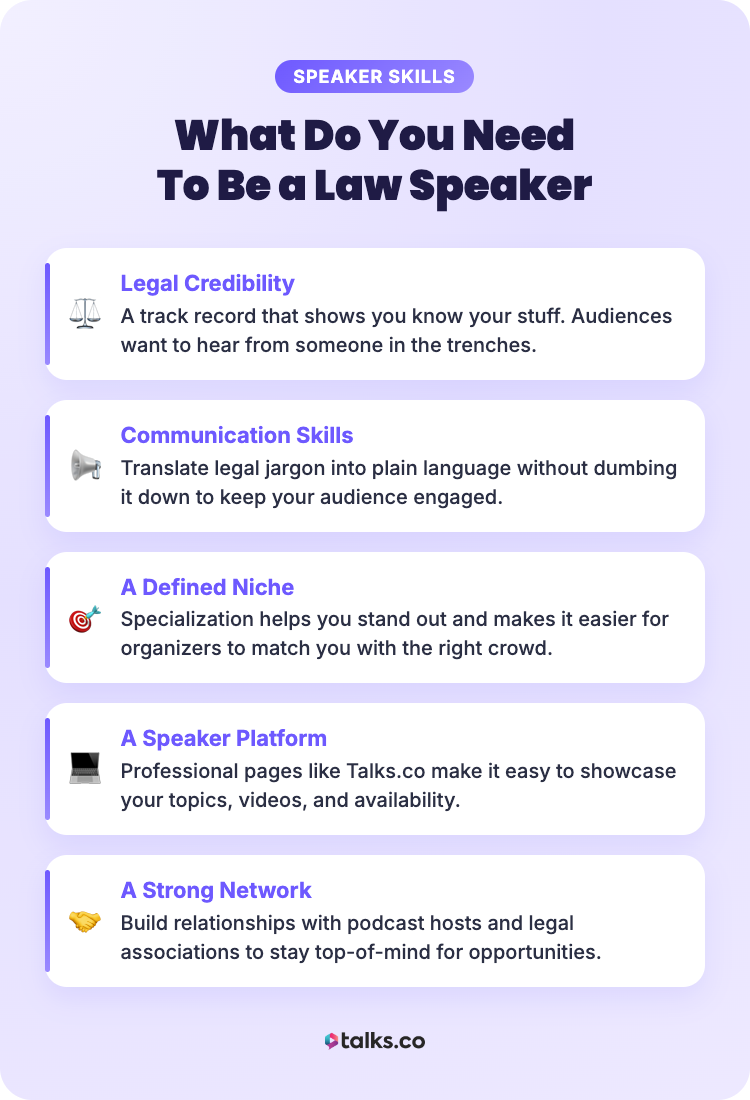
The assumption most hosts carry into the booking decision is that legal credibility is the signal.
☑︎ JD from a real school.
☑︎ Years in practice.
☑︎ Courtroom time.
☑︎ A publication (or two).
Check all the boxes, put them on stage, and trust the expertise to carry the room.
What the room actually needs is someone who can make a non-lawyer feel the weight of a compliance risk, understand their exposure in plain language, and walk out with something they’ll still remember on Tuesday.
Those are different skills. The second set doesn’t come with the bar admission.
Take Nichole Compton. She’s an attorney. Her tagline is “That One Attorney Speaker that Makes You Smile and Shine.”
That’s an audience promise, not a resume line. She’s not leading with the credential. She’s leading with how the room is going to feel.
Contrast that with John Camacho, whose topics are sports, law, and business, and whose positioning is simply “Sports for Smart Fans.”
He’s not pitching legal expertise to lawyers. He’s pitching access and clarity to people who love sport and want to understand the business side of it.
Then there’s Olivia Singh: “Law-trained. Tech-savvy. Built for the stage.” Three words of credential, two words of capability, four words of positioning.
That’s a booking-ready sentence.
And Jen Lee, described as an attorney who challenges the status quo in law, speaks on entrepreneurship, management, and marketing. She’s not in the room for lawyers. She’s in the room for founders.
Every one of those framings is doing the same thing: entering the audience’s world before asking the audience to enter theirs.
The Credential Stack Is a Starting Point, Not the Decision
Credentials matter for one thing: confirming the speaker isn’t fabricating their foundation. That the knowledge underneath the talk is real and checkable.
After that, they’re largely irrelevant to how the talk performs.
What moves it is closer to this: can this person take something genuinely complex and make it land for someone who didn’t study it? Do they avoid jargon as a reflex? Does watching their past appearances suggest they’ve thought about the audience as much as the material?
A speaker who sounds like a legal brief in their talks will sound like a legal brief at your event. The credential on the bio won’t fix that in the room.
The law speakers gaining traction aren’t generalists with impressive histories. They’re specific, positioned, and built for a named audience with a named problem. Niche plus translation equals a speaker the room remembers.
That’s the formula, and it holds across every profile worth looking at.
Being the go-to law speaker on a defined legal topic for a defined industry is a position worth building deliberately. The speakers who’ve done that are the ones who hold rooms and get rebooked.
Credentials verify the foundation. They don’t predict whether the room walks out having understood anything.
The Booking Question Worth Asking
The better filter isn’t “does this person know enough law.” It’s “Does this person know how to make my audience care about the law that applies to them?”
Those are different questions. One gets answered by checking the bio. The other gets answered by watching the talk.
“I don’t just cover the topic. I cover the topic for people who have to make decisions about it without a law degree.”
That’s the frame that books. That’s the frame that gets remembered. That’s what separates a law speaker from a lawyer who speaks.
If you’re looking for the right law speaker for your next event or podcast, the full law speakers list is worth browsing on Talks.
Who are you trying to reach right now? If you’ve got an event or a podcast and you’re figuring out who belongs on it, hit reply.
Always happy to think it through with you.
Keep Talking,
Liam
~
Visibility systems to grow your personal brand, audience + authority with guest appearances. First online sale in 2001. Built multiple 6–7 figure online businesses. 400+ interviews. Malta, Stockholm, Sydney. Love soccer, surf & burritos.