
The Best Software for Podcast Interviews Won't Save a Bad Conversation
What I learned about the best software for podcast interviews after 400 conversations on both sides of the mic.

In 2015 I used Zoom.
Everyone did. It was the obvious choice. I was hosting my first virtual summit, interviewing 35 guest speakers back to back, and Zoom worked. Guests could join without friction. I could record. I could move on to the next conversation.
I didn’t think about the software again for a long time.
That’s the thing about recording software when it’s working. You forget it’s there. You’re thinking about the guest. The questions. Whether the conversation is going somewhere worth keeping. The software just runs in the background and does its job.
It only becomes visible when it fails you.
The Best Software for Podcast Interviews Didn’t Stay Zoom
A few years in, something shifted.
I started showing up as a guest on other people’s shows. That flipped the perspective. Instead of setting up the recording and sending the link, I was the one receiving it. And I started noticing what the best hosts were using.
Not Zoom.
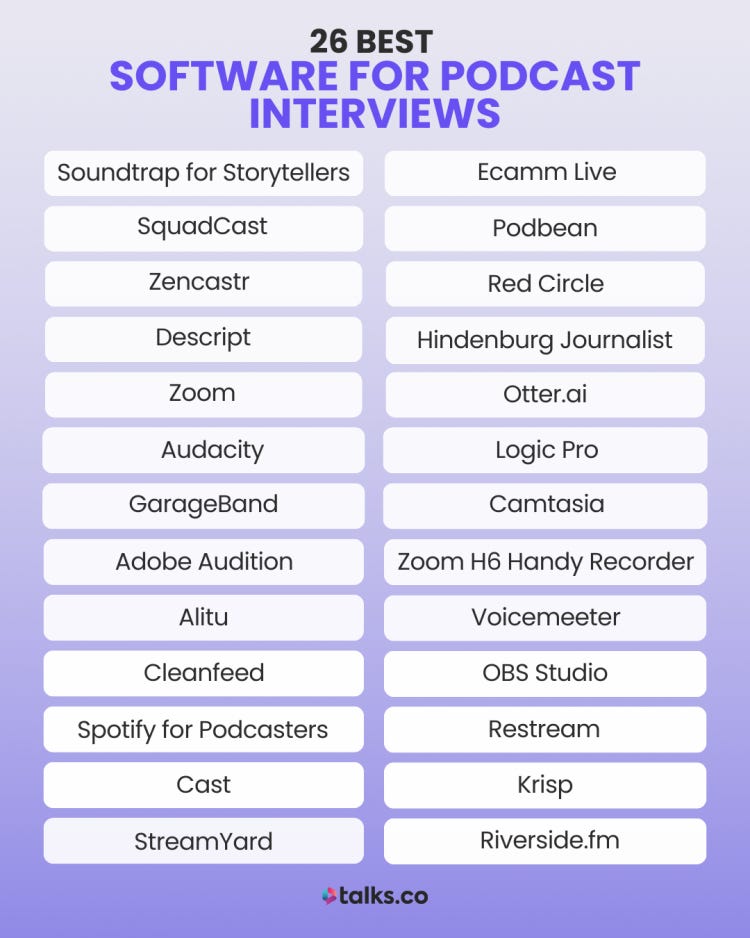
Riverside. Squadcast.
Tools built specifically for podcast interviews, not video calls that had been repurposed for them. Browser-based, so I didn’t have to install anything before we recorded.
Separate local tracks for host and guest, so if my connection dropped mid-sentence it didn’t ruin the episode.
Video quality good enough to clip and share on social media, not just passable enough to stream.
The difference wasn’t dramatic. But it was real. You could feel it in how the session started. No friction. No “can you hear me?” for three minutes while someone hunts for the right audio settings.
Just a link, a browser tab, and a conversation.
I noticed it because the contrast was there. I’d been on the other side long enough to recognize when something was built for the job versus borrowed from somewhere adjacent.
What 10+ Years Worth of Interviews Eventually Taught Me
The software question I get asked most often is some version of: which one should I use?
After 400+ interviews as both host and guest, my answer is simpler than people expect.
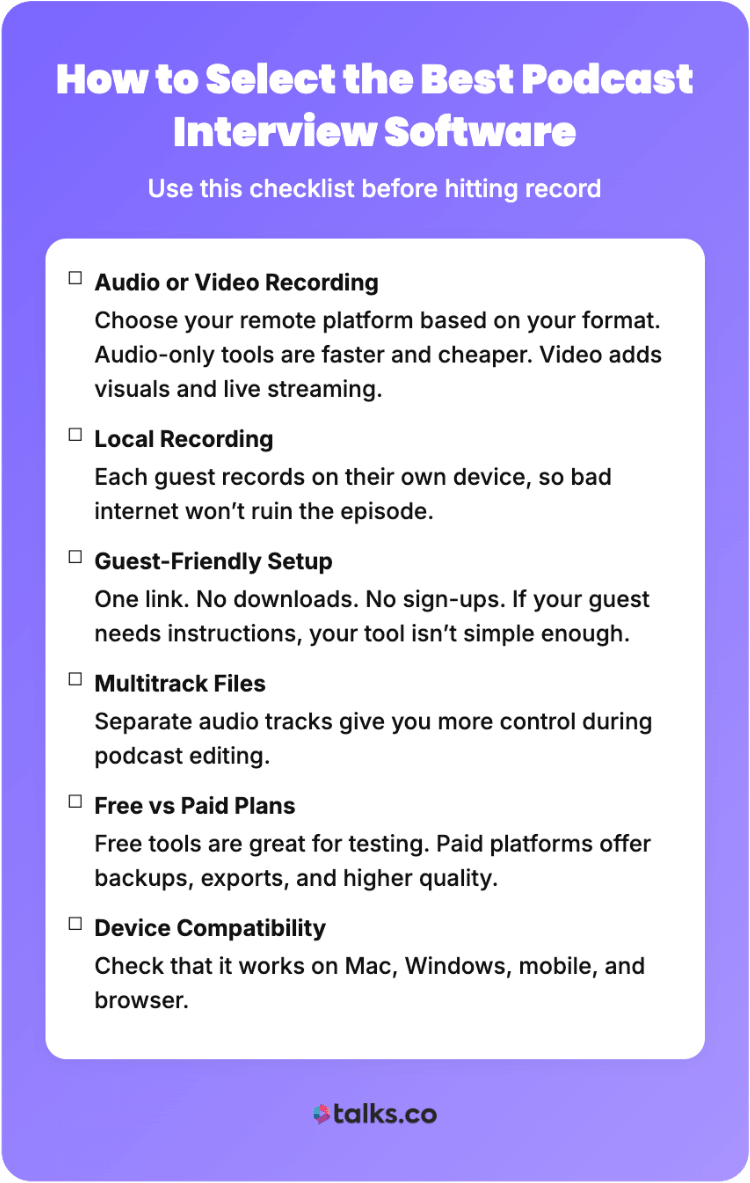
Use something built for podcast interviews, not repurposed from something else.
☐ Browser-based so your guest shows up without a support ticket.
☐ Local track recording so a bad connection doesn’t cost you the episode.
☐ Video quality worth sharing, because the clip is often where the reach lives now, not the full episode.
That’s it. Everything beyond that is preference.
What I’ve learned is that most of the anxiety around software isn’t really about the software. It’s about readiness.
The first time I sat down as a guest, I’d already hosted over a dozen interviews. I knew the tech. I’d dealt with dropped connections, bad audio from hotel lobbies, guests who couldn’t find the mute button.
I still got nervous.
I prepared my talking points. Had a glass of water next to me. Made sure I was in a comfortable chair. And the moment we started talking, it felt like a conversation. Not perfect. Authentic.
The software didn’t change any of that. It just needed to stay out of the way long enough for the conversation to happen.
The best software for podcast interviews is the one that disappears once you press record.
The Podcast I Still Haven’t Started
I’ve done over 400 interviews. Co-founded Talks.co to connect experts with podcast hosts. Built a community of 300,000 entrepreneurs.
I haven’t launched my own podcast yet.
That’s not because I couldn’t figure out the software. I know exactly what I’d use.
It’s because I made a deliberate choice early on to do summits instead, because I needed revenue fast. My first summit added 15,000 leads to our list. My first 35 interviews generated $50,000. The podcast kept getting scheduled for later.
Later kept moving.
I’m starting in 2026. The software decision will take an afternoon. It always does, once you stop using it as a reason to wait.
The software question is almost never really about the software.
What I wish someone had told me in 2015: the best software for podcast interviews is a one-afternoon decision. Learn it once, then stop thinking about it.
The conversation is where the work is. The software just needs to hold it.
Ten years of interviews taught me that. I could have figured it out in the first week if I’d been willing to stop looking for a reason to delay.
If you want the actual breakdown of which tools are worth your time, I put together a full guide to the best software for podcast interviews covering what each one does, what it costs, and how to choose.
What’s the thing you keep telling yourself you’ll sort out before you start? The software, the setup, the niche, the name?
Drop it in the comments. I’m curious whether it’s just me who does this or whether every person building something has their own version of that excuse.
Keep Talking,
Liam
~
Visibility systems to grow your personal brand, audience + authority with guest appearances. First online sale in 2001. Built multiple 6–7 figure online businesses. 400+ interviews. Malta, Stockholm, Sydney. Love soccer, surf & burritos.
I have a different platform that I love -- https://Meetn.com It is so easy to show videos and slides. Hitting record and streaming is a snap too. Plus, the calls to action buttons and the welcome messages are pre-loaded.
Never a stumble as to the meeting login as the URL stays the same. I get a call even when a person goes to the waiting room. See some past recordings at https://WAFSU.org. We hold weekly meetings for swim coaches. Ping me and we can meet there if you wish. Then the recordings often flow into my podcast, Heavy Or Not, The OG Swim Guide. On the podcast, I shy away from typical interviews.